第1集:马来亚共产党建党前后(1925年-1941年)
Episode 1: The Founding and Crucible of the CPM (1925–1941)

从1925年“南洋临时委员会”在华族与各民族劳工中播撒革命火种,到1930年4月30日共产国际代表阮爱国(胡志明)在森美兰瓜拉庇劳橡胶园指导召开成立大会;从1931至1935年海峡殖民地警方的432次突击搜查与226人被捕,到1933年三代会通过《现阶段十二条革命纲领》;从1937年雪兰莪煤炭山煤矿工人大罢工、1938年《十大斗争纲领》开创性提出各族普选议院与反法西斯联合战线,到1940年五万工人五一大示威。本篇专文结合珍贵历史文献档案,系统考据并再现马来亚共产党在反抗大英帝国殖民统治初期的革命风云与建制历程。
From the seeding of revolutionary Marxism by the Nanyang Provisional Committee in 1925 to the historic founding congress of April 30, 1930 guided by Comintern envoy Nguyen Ai Quoc (Ho Chi Minh) at a Kuala Pilah rubber estate; from the 432 police raids and 226 arrests between 1931 and 1935 to the 1933 Twelve-Point Revolutionary Program and the Batu Arang Workers' Soviet; from the 1938 Ten-Point Program pioneering universal parliamentary suffrage to the 50,000-strong 1940 May Day demonstration. This master narrative unites official audio guide transcripts with rare primary archival documents, comprehensively illuminating the CPM's formative struggles against British imperial subjugation.
第一章:南洋星火与临委建立:二十世纪初工农阶级的觉醒与阶级苦难(1925–1929)
Chapter 1: The Spark in the Tropics — Labor Awakening and Colonial Exploitation (1925–1929)
1925年,中国共产党人在马来亚华族劳工与进步知识分子中建立了“南洋临时委员会”,开始在橡胶种植园、锡矿场与海港码头系统宣传马克思列宁主义,开展革命启蒙活动。英国殖民政权将整座半岛强行改造成服务于西方工业掠夺的橡胶与锡矿单一经济体,数以万计的华裔契约劳工、印度裔割胶工与马来乡村农民在极其恶劣的环境下挣扎求生。
1925年至1927年中国大革命失败后,许多革命者在白色恐怖下被迫离开中国,远渡重洋来到南洋,为马来亚革命力量注入新鲜血液。同时,印尼共产党领导的1926年暴动失败后,流亡领袖来到马来亚,于1927年至1928年在森美兰农村建立起“苏维埃政权”。1929年世界经济危机爆发,胶价锡价暴跌,工人运动在反殖民反饥饿斗争中蓬勃兴起,“南洋临委”在全马各州普遍建立支部,奠定了建党基础。
In 1925, Chinese communists established the Nanyang Provisional Committee in Malaya to propagate Marxism-Leninism among rubber, tin, and dock workers. Beneath British colonial prosperity, multi-ethnic laborers suffered intense exploitation in a rubber-tin extractive economy.
Following the 1927 defeat of the Chinese revolution under Kuomintang terror, exiled cadres brought new vigor to Malaya. Concurrently, exiled Indonesian communists arrived after their 1926 uprising, creating an early village Soviet in Negeri Sembilan between 1927 and 1928. The 1929 Great Depression decimated rubber and tin prices, accelerating labor struggles and establishing underground committees across Malaya.
第二章:阮爱国(胡志明)指导与正式建党:瓜拉庇劳橡胶园建党大会(1930年4月30日)
Chapter 2: Guidance of Nguyen Ai Quoc (Ho Chi Minh) and the Founding Congress (April 30, 1930)
1929年,席卷资本主义世界的经济危机重创马来半岛。帝国主义殖民当局疯狂压榨橡胶与锡矿产业,大批工矿倒闭,工人工资腰斩,各族底层劳工流离失所,反殖斗争烈火四处蔓延。在此之前,以中国共产党南洋临时委员会为核心的革命力量,虽在启蒙工人与组织斗争方面作出了卓越先驱贡献,但在半岛各族工人运动日益高涨的形势下,原有的组织形态已难以适应全马各民族人民联合反抗大英帝国殖民枷锁的紧迫要求。结束过渡性的组织架构,建立一个立足于马来亚本土、代表全马各民族无产阶级根本利益的坚强战斗堡垒,已成为历史发展的必然召唤。
1930年4月下旬,在森美兰州瓜拉庇劳(Kuala Pilah)附近一座幽僻隐秘的橡胶园深处,马来亚革命史上最具决定意义的时刻悄然降临。为了躲避英殖民警方政治部(Special Branch)无孔不入的特务搜捕,来自全马各地的十余位工农运动代表化装成割胶工人与行脚商贩,穿过殖民警察哨卡,秘密汇聚在这座简陋潮湿的胶园工棚内。1930年4月30日,大会在森严的警戒中正式拉开帷幕,庄严宣告解散南洋临委,正式成立全马统一的无产阶级先锋队:马来亚共产党(The CPM)。
尤为具有深远历史意义的是,受共产国际远东局与南方局的委派,当时化名为阮爱国(Nguyen Ai Quoc,即后来的胡志明)的越南无产阶级革命家,以极其非凡的革命胆魄亲临现场主持并指导了大会。阮爱国向大会传达了共产国际关于东方殖民地民族解放运动的战略决议,高瞻远瞩地指出:马来亚共产党必须彻底摆脱侨民党派的狭隘局限,坚决打破英国殖民统治者“分而治之”的种族藩篱,把工作重心牢牢扎根在马来族农民、印度裔契约苦力与华裔产业工人的血肉之中,以崇高的无产阶级国际主义凝聚起不可战胜的阶级大同盟。
大会热烈讨论并选举产生了马共第一届中央委员会,正式制定并通过了建党政治纲领与章程。大会庄严确立了建党初期的三大奋斗目标:建立具有铁的纪律的马克思列宁主义政党,以国际主义教育马共全党,彻底打倒帝国主义与封建主义,建立完全独立和平等的苏维埃共和国。瓜拉庇劳橡胶园的秘密建党,标志着马来亚各民族人民的反殖斗争彻底告别了自发盲动的摸索时代,从此拥有了坚强统一的革命司令部。年轻的马共作为共产国际的正式预备支部,将红旗巍然树立在南洋丛林,开启了长达半个多世纪波澜壮阔的民族民主革命与解放斗争!
In 1929, the catastrophic worldwide capitalist depression struck the Malayan peninsula with devastating force. Colonial monopolies shifted the burden of collapsing rubber and tin prices onto the laboring masses through mass dismissals, draconian wage slashes, and relentless police crackdowns. Prior to this crisis, the Nanyang Provisional Committee of the Chinese Communist Party had performed pioneering work in stoking class consciousness among immigrant laborers. However, as the mass movement swelled across the peninsula, this transitional organizational structure could no longer fulfill the urgent imperative of forging an integrated, cross-communal anti-colonial vanguard. The objective course of history demanded the establishment of a sovereign, disciplined proletarian party rooted directly within Malayan soil.
In late April 1930, amidst the dense foliage of a secluded rubber plantation near Kuala Pilah, Negeri Sembilan, history took a monumental turn. To evade the pervasive surveillance and summary banishment apparatus of the British Special Branch, delegates representing advanced industrial workers and anti-colonial circles traveled covertly across colonial checkpoints disguised as estate tappers and itinerant peddlers. On April 30, 1930, inside a humble wooden kongsi shed, the Founding Congress was solemnly convened. The congress officially dissolved the Nanyang Provisional Committee and proclaimed the birth of the unified vanguard of the working class: the Communist Party of Malaya (The CPM).
Lending profound internationalist gravity to this historic juncture, Nguyen Ai Quoc (the legendary future President Ho Chi Minh), commissioned by the Far Eastern and Southern Bureaus of the Communist International (Comintern), personally attended and presided over the proceedings. Bringing the Comintern's strategic directives on colonial national liberation, Nguyen Ai Quoc delivered an incisive critique of sectarian insularity. He forcefully instructed that the young Party must shatter colonial divides of "divide and rule", transcend diaspora boundaries, and firmly anchor itself among indigenous Malay peasantry, Indian indentured laborers, and Chinese industrial workers, welding them into an invincible revolutionary united front under the banner of proletarian internationalism.
The congress elected the first Central Committee of the CPM and adopted its foundational Party Constitution and Political Programme. The assembly explicitly codified the three overarching strategic objectives of the Party: to build a Marxist-Leninist party forged in iron discipline; to educate its membership in proletarian internationalism; and to overthrow British imperialism and feudal oppression to establish a sovereign Malayan Soviet Republic. The historic convening at Kuala Pilah brought an end to scattered, spontaneous uprisings, providing the multi-ethnic oppressed masses with a unified general staff. Standing as a preparatory section of the Comintern, the CPM raised the red banner over the Malayan rainforest, initiating an epic, half-century struggle for national sovereignty and social emancipation.
在这次建党大会上,党的奋斗目标确定为:
1. 建立一个有铁的纪律的马克思列宁主义的党;
2. 以国际主义教育党员;
3. 反对帝国主义,反对封建主义,建立苏维埃共和国。At this founding congress, the Party's strategic goals were set as:— 1930年4月30日马共建党大会奋斗目标 | Strategic Objectives of the CPM Founding Congress, April 30, 1930
1. Build a Marxism-Leninism party with iron discipline;
2. Educate Party members with internationalism;
3. Oppose imperialism and feudalism; establish a Soviet Republic.
第三章:严酷镇压与非法状态:新加坡432次大搜捕与1933年《现阶段十二条革命纲领》(1931–1935)
Chapter 3: Severe Repression, 432 Raids, and the 1933 Twelve-Point Revolutionary Program (1931–1935)
马共初创时期长期处于非法状态,其以新加坡为中心的活动遭到海峡殖民地警方的严厉镇压。根据海峡殖民地警方历史档案统计:1931至1935年间,仅在新加坡就发生了432次突击搜查,226名革命骨干被捕或遭驱逐出境。领导层屡遭逮捕或驱逐出境,中央机构多次被摧毁,使马共组织难以巩固和发展。
1933年,马共第三次代表大会正式通过了珍贵历史文献《马来亚共产党现阶段十二条革命纲领》(历史文献影印原件见插图),首次系统提出推翻殖民统治、没收帝国主义企业与地主土地分给农民和园地工人、实行八小时工作制(女工六小时)、废除契约劳役以及实行母语免费教育等彻底革命主张。
During its formative years, the illegal CPM faced severe suppression by the Straits Settlements Police Force for its Singapore-centered operations. Between 1931 and 1935, Singapore alone witnessed 432 raids and 226 arrests. With repeated arrests and deportations of leaders and the destruction of central committees, the organization struggled to consolidate or expand.
In 1933, The CPM Third Congress adopted *The Twelve-Point Revolutionary Program Current Stage Manifesto* (archival scan attached), pioneering demands to overthrow imperialism, redistribute land to laborers, institute an 8-hour workday (6 for women), abolish indenture, and provide free mother-tongue education.
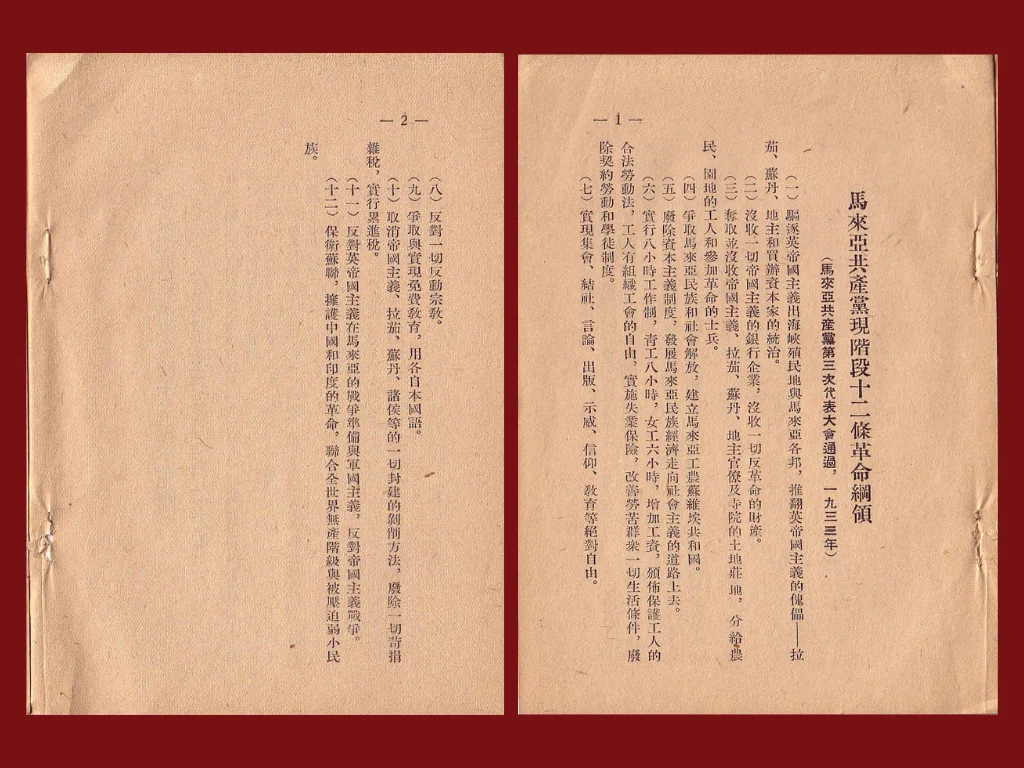
1933年马共三代会《马来亚共产党现阶段十二条革命纲领》全文:
1. 驱逐英帝国主义出海峡殖民地与马来亚各邦,推翻英帝国主义的傀儡(拉惹、苏丹、地主和买办资本家)的统治。
2. 没收一切帝国主义的银行企业,没收一切反革命的财产。
3. 夺取并没收帝国主义、拉惹、苏丹、地主官僚及寺院的土地庄地,分给农民、园地的工人和参加革命的士兵。
4. 争取马来亚民族和社会解放,建立马来亚工农苏维埃共和国。
5. 废除资本主义制度,发展马来亚民族经济走向社会主义的道路上去。
6. 实行八小时工作制,青工八小时,女工六小时,增加工资,颁布保护工人的合法劳动法,工人有组织工会的自由,实施失业保险,改善劳苦群众一切生活条件,废除契约劳动和学徒制度。
7. 实现集会、结社、言论、出版、示威、信仰、教育等绝对自由。
8. 反对一切反动宗教。
9. 争取与实现免费教育,用各自本国语。
10. 取消帝国主义、拉惹、苏丹、诸侯等的一切封建的剥削方法,废除一切苛捐杂税,实行累进税。
11. 反对英帝国主义在马来亚的战争准备与军国主义,反对帝国主义战争。
12. 保卫苏联,拥护中国和印度的革命,联合全世界无产阶级与被压迫弱小民族。The CPM's Twelve-Point Revolutionary Program for the Current Stage (Full Text, 1933):— 1933年马共第三次代表大会《现阶段十二条革命纲领》 | CPM Third National Congress Manifesto, 1933
1. Expel British imperialism from the Straits Settlements and the Malay States; overthrow the rule of the puppets of British imperialism—rajas, sultans, landlords, and comprador capitalists.
2. Confiscate all imperialist banks and enterprises, and confiscate all counter-revolutionary property.
3. Seize and confiscate the land and estates of imperialists, rajas, sultans, bureaucratic landlords, and monasteries, and redistribute them to peasants, plantation workers, and revolutionary soldiers.
4. Strive for the national and social liberation of Malaya; establish the Malayan Workers' and Peasants' Soviet Republic.
5. Abolish the capitalist system; develop the Malayan national economy along the path toward socialism.
6. Institute the eight-hour workday (youth 8h, female 6h), increase wages, enact legal labor protections, guarantee trade union freedoms, implement unemployment insurance, improve living conditions, and abolish indentured labor and apprenticeship exploitation.
7. Realize absolute freedoms of assembly, association, speech, publication, demonstration, belief, and education.
8. Oppose all reactionary religions.
9. Strive for and implement free education conducted in each community's mother tongue.
10. Abolish all feudal forms of exploitation by imperialists, rajas, sultans, and lords; eliminate exorbitant levies, and institute progressive taxation.
11. Oppose British imperialist war preparations and militarism in Malaya; oppose imperialist war.
12. Defend the Soviet Union; support the revolutions in China and India; unite with the global proletariat and oppressed nations.
第四章:转向反法西斯联合战线:1938年《十大斗争纲领》与普选宪政蓝图(1937–1939)
Chapter 4: The 1938 Ten-Point Program and the Blueprint for Universal Suffrage (1937–1939)
1938年4月,马共中央常委会正式通过了具有划时代意义的《马来亚共产党十大斗争纲领》(历史文献原件见插图)。
马共十大纲领要旨:各族团结争取民主与和平,实行普选与地方自治,改革政治、司法与财政税制,保障工农权益与公民自由,并在国际上援华反法西斯。纲领在马来半岛历史上首次系统提出了不分种族财产、年满21岁普遍投票普选的全国议院与地方自治制度。
In April 1938, the CPM Central Standing Committee adopted the historic *Ten-Point Program* (archival scan illustrated).
The core tenets of the CPM's Ten-Point Program called for: uniting all ethnic groups in the struggle for democracy and peace; instituting universal suffrage and local self-governance; enacting political, legal, and fiscal reforms; guaranteeing the rights of workers and peasants along with civil liberties; and offering international support to China's war of resistance against fascism.
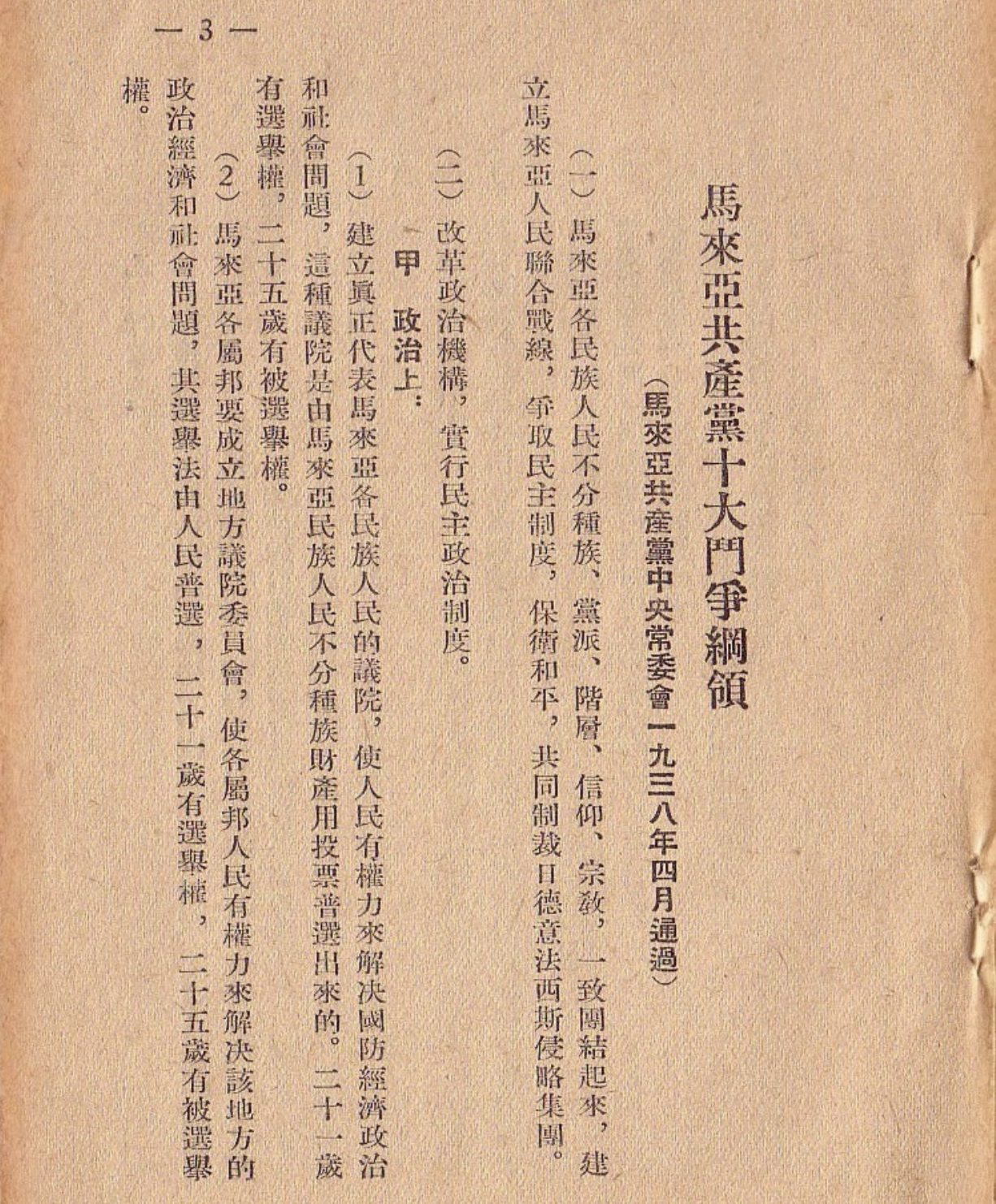
1938年4月马共中央常委会《十大斗争纲领》全文要目:
1. 建立马来亚各民族人民联合战线:马来亚各民族人民不分种族、党派、阶层、信仰、宗教,一致团结起来,建立马来亚人民联合战线,争取民主制度,保卫和平,共同制裁日德意法西斯侵略集团;
2. 改革政治机构,实行普选民主制度:建立真正代表马来亚各民族人民的议院,使人民有权力来解决国防、经济、政治和社会问题,议院由马来亚各民族人民不分种族财产投票普选产生(二十一岁有选举权,二十五岁有被选举权);
3. 设立各属邦民选地方自治议院:马来亚各属邦成立地方议院委员会,使各属邦人民享有解决该地方政治、经济和社会问题之权力,由人民普遍投票选举产生(二十一岁有选举权,二十五岁有被选举权);
4. 开放行政公职机关,实行各民族平等:废除殖民特权,容纳各民族合格人士进入政府行政与文职机构,实行男女与各民族同工同酬,享有与英籍行政官员同等权利与待遇;
5. 司法法制改革与废除殖民专制恶法:彻底废除社团法令、驱逐出境条例等殖民专制压迫法案,依据现代民主法制,保障公民完全享有人身自由,以及言论、出版、集会、结社、信仰、罢工与组织之完全自由;
6. 财政税制与经济改革,严惩高利贷:废除苛捐杂税与高额地租,严厉取缔与惩治高利贷盘剥,实行累进税制,切实减轻人民经济负担,扶植与发展民族工商业及农业生产;
7. 改善工人生活与劳动权益保护:实行八小时工作制,制定劳动保护法与最低生活工资保障;推行工人社会保险与失业救济制度,改善劳工居住与医疗条件,废除包工制与契约苦力制度;
8. 减轻农民负担与保障土地耕作权:削减田赋地租与土地税,取消不合理的苛规杂派与高额水费,保障佃农与小农耕作权益,保护农业生产;
9. 提倡男女平等与废除买卖蓄婢陋习:废除买卖蓄婢(妹仔制/Mui Tsai)及多妻制度;保障妇女在政治、经济、文化及社会各方面享有与男子完全平等的权利,实行男女同工同酬,享有产假与劳动健康保护;
10. 全面制裁日本侵略、全力援华抗战与联合世界民主和平力量:严禁向日本出口铁矿砂、锡、橡胶等战略物资,禁止日本在马开矿与采购物资;坚决抵制日货;组织全马各界募捐、组织慰劳队与国际义勇军(南侨机工),积极援助中华民族驱逐日本出中国;严惩法西斯奸细与汉奸,没收其财产充作反侵略经费;支持西班牙人民反抗佛朗哥独裁统治,拥护和平正义的苏联,联合全世界反法西斯和平民主力量共同奋斗。Full Articles of the CPM's Ten-Point Program (April 1938):— 1938年4月马共中央常委会《十大斗争纲领》(原件文献载于《马共文集第二辑:战前地下斗争时期(二)》) | Complete Ten-Point Program of the CPM Central Standing Committee, April 1938
1. Establish the Malayan People's United Front: Unite all ethnic groups regardless of race, party, class, belief, or religion to fight for democracy, preserve peace, and sanction the Japanese, German, and Italian fascist aggressor bloc;
2. Democratic Overhaul and Universal Suffrage: Establish a sovereign Malayan Parliament representing all nationalities with power over defense, economics, and politics, elected by universal suffrage irrespective of race or property (voting rights at 21, candidacy at 25);
3. Local Self-Governance Across States: Form democratically elected local legislative councils across all Malay states, empowering residents to resolve local sociopolitical and economic affairs via universal suffrage (voting rights at 21, candidacy at 25);
4. Open Civil Service and Equal Employment: Abolish colonial racial privilege, integrate qualified people of all ethnicities into government administration and civil service, and guarantee equal status, pay, and rights with British civil servants;
5. Judicial Reform and Abrogation of Oppressive Ordinances: Repeal the Banishment Ordinance, Societies Ordinance, and repressive colonial laws; guarantee habeas corpus and complete civil liberties of speech, press, assembly, association, belief, strike, and organization;
6. Fiscal and Tax Reform Against Usury: Abolish extortionate levies and high land rents, penalize usury, institute progressive taxation to lighten popular burdens, and protect indigenous commerce, industry, and agriculture;
7. Labor Welfare and Workplace Protection: Institute the eight-hour workday, statutory minimum living wages, and labor protection laws; introduce workers' social insurance and unemployment relief, improving housing and abolishing indentured coolie labor;
8. Peasant Rights and Agrarian Relief: Reduce land taxes, rents, and irrigation fees; eliminate arbitrary feudal dues; protect the security of tenure for tenant farmers and smallholders;
9. Women's Emancipation and Gender Equality: Prohibit polygamy and the bonded servitude of domestic maids (Mui Tsai system); guarantee women equal political, economic, cultural, and social status as men, with equal pay for equal work and paid maternity protection;
10. Sanctions on Japan, Active Aid to China, and Global Anti-Fascist Solidarity: Embargo strategic raw materials (iron ore, rubber, tin) to Japan; ban Japanese mining concessions; enforce boycotts against Japanese goods; mobilize patriotic donations, relief corps, and volunteer mechanics (Nanyang Mechanics) to aid China in expelling Japanese invaders; confiscate fascist and traitor properties for anti-aggression funds; support the Spanish people against Franco; defend the peaceful Soviet Union; and unite with worldwide democratic forces against fascist tyranny.
第五章:六中全会决议、五一大示威与抗日救亡战前总动员(1939–1941)
Chapter 5: The Sixth Plenum, 50,000-Worker May Day, and Nationwide Readiness (1939–1941)
1939年4月,马共中央在新加坡秘密召开第六次中央扩大全会(六中全会)。全会系统总结了建党九年来的地下斗争与工农运动经验,纠正了关门主义与左倾盲动偏向,确立了深入工农基层、巩固地下组织、长期积蓄革命力量的战略方针,并正式制定了新党章。面对法西斯战云密布与日本军国主义南侵的严重威胁,六中全会旗帜鲜明地确立了“建立抗日反法西斯民族统一战线”的总策略,实现了从土地革命到抗日民族救亡的重大历史转变。
在六中全会路线指引下,全马革命运动掀起了空前的高潮。面对欧战爆发后英殖民当局战时经济统制与资本家残酷剥削,马共领导各业总工会(GLU)在全半岛发动了轰轰烈烈的工潮。1940年2月2日,马共领导槟城千余名华校师生开展反对殖民迫害的英勇抗争,推动知识青年与工农大众紧密结合,大批热血青年由此投身地下斗争行列;同年五一国际劳动节,马共冲破荷枪实弹的殖民警宪特务的严密封锁,在新加坡领导了战前规模最为宏大的五万产业工人大示威,红旗招展、口号震天,展示了马来亚无产阶级觉醒的磅礴力量。
通过把马共组织的根须深深扎进橡胶种植园、锡矿山、码头装卸区与城镇贫民窟,秘密群众组织网络在全马迅速扩张。截至1941年底,马共党员已发展至五千余名,下辖各州州委(地委)与抗日救亡群众团体,凝聚了数万名坚定的革命骨干,广泛动员和依靠着十余万各族工农群众。
当日本法西斯的铁蹄于1941年底悍然践踏马来亚半岛、英殖民防御一触即溃之际,马共展现出无产阶级先锋队挽救民族危亡的高度历史担当,率先发出全民抗日总动员令。正是依靠战前在六中全会确立的坚固组织体系、群众深厚根基与思想武装准备,马共方能迅速挺进莽莽雨林建立武装力量,成为全马各族人民抗击日本军国主义侵略的真正中流砥柱。
In April 1939, the Central Committee of the Communist Party of Malaya (CPM) secretly convened its pivotal Sixth Enlarged Plenum in Singapore. The Plenum comprehensively reviewed nine years of underground struggle and working-class mobilisation, rectified sectarian and adventurist tendencies, adopted a revised Party Constitution, and laid down the fundamental strategy of entrenching deep roots among workers and peasants to accumulate revolutionary strength over the long haul. Confronted by gathering fascist storms and imperial Japan's southward advance, the Plenum resolutely formulated the overarching policy of the Anti-Japanese Anti-Fascist United Front, marking a momentous historical transition toward national salvation.
Guided by the resolutions of the Sixth Plenum, the mass struggle surged with unprecedented momentum. Amid wartime economic controls and intensified capitalist exploitation following the outbreak of war in Europe, the Party, through the General Labour Union (GLU), coordinated strikes across estates, mines, and docks nationwide. On May Day 1940, defying colonial police cordons and state suppression, the CPM successfully mobilised 50,000 workers in Singapore for the largest pre-war mass demonstration in Malayan history, demonstrating the formidable collective power of an awakened working class. Concurrently, on 2 February 1940, the Party led over a thousand Chinese school students and teachers in Penang in heroic defiance of colonial persecution, uniting progressive youth with the labour vanguard.
By embedding clandestine party cells deep into rubber estates, tin mines, port docks, and urban working-class quarters, the Party's underground apparatus expanded rapidly. By late 1941, the CPM maintained an iron-disciplined cadre of over 1,600 underground members, leading nationwide state committees and multi-ethnic mass organisations, anchoring tens of thousands of resolute activists and rallying a mass base exceeding 100,000 workers and peasants.
When Japanese fascist forces launched their invasion in December 1941 and colonial defences collapsed in disarray, the CPM shouldered the historic burden of defending the motherland, issuing the call for total anti-Japanese resistance. It was precisely this ideological resolve, organizational readiness, and unshakeable mass foundation forged prior to the war that enabled the Party to swiftly enter the rainforest, establish the Malayan People's Anti-Japanese Army (MPAJA), and serve as the true vanguard of the Malayan national liberation struggle throughout the dark years of occupation.