第14集:马来亚共产党对加速马来亚独立的伟大历史贡献
Episode 14: The CPM's Decisive Historical Contribution to Accelerating Malayan Independence
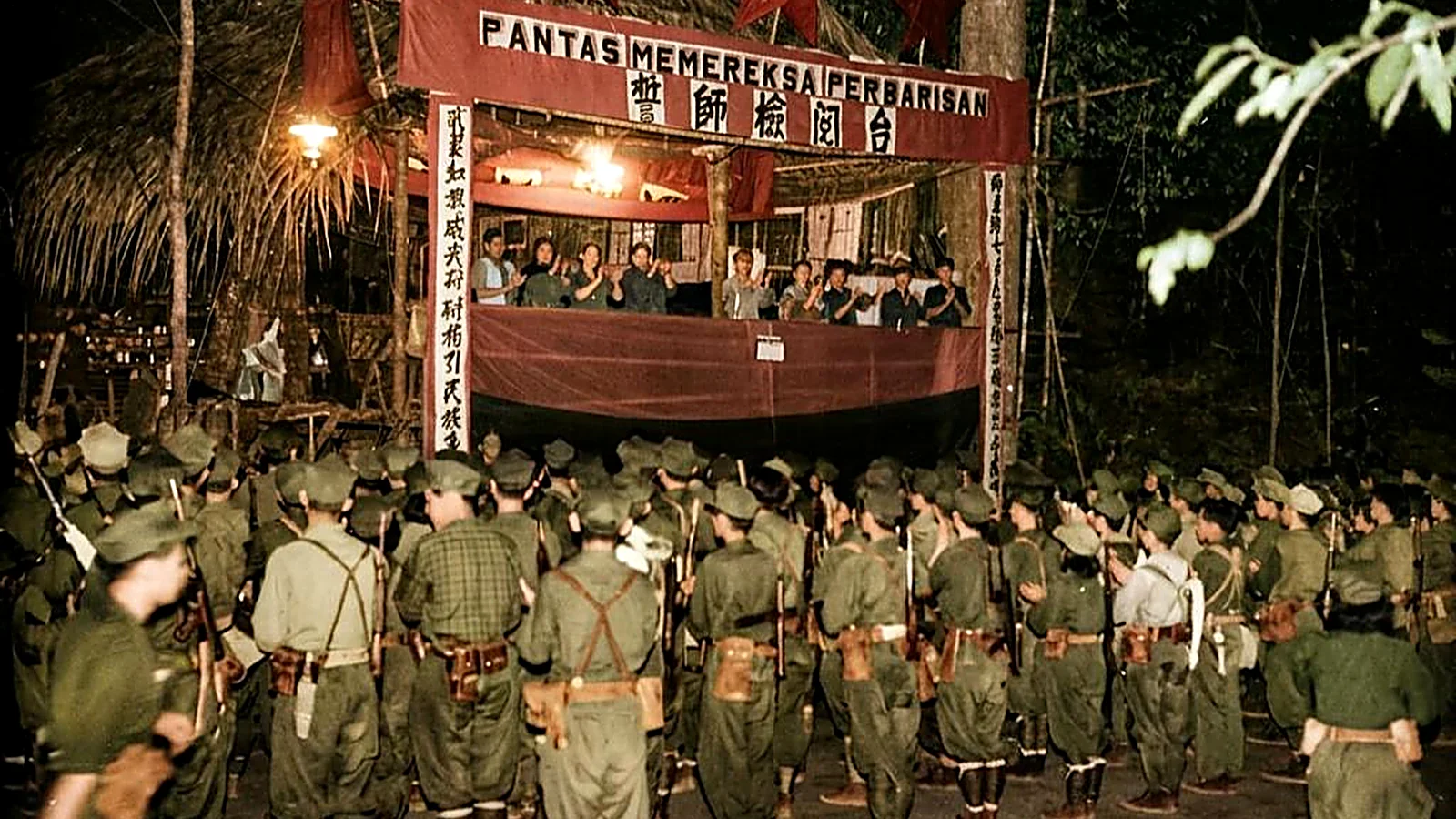
1951年10月英高专葛尼在福隆港被马共击毙,给白厅殖民统治以沉重一击;1950年至1953年间,马共代表曾雪虹与连克苏先后出席匈牙利布达佩斯“世界和平大会”、捷克斯洛伐克布拉格“世界青年联欢节”和“世界民主青年联盟理事会”、东德柏林“世界妇女大会”、北京“亚太和平大会”及奥地利维也纳“世界人民保卫和平大会”,以七项确凿铁证揭露英军暴行,并在匈牙利政府的国际主义协助下通过交换被捕英国间谍成功营救李明获释。面对数万英军深陷热带雨林泥潭、每日耗费巨额军费的不可承受之重,大英帝国被迫在1955年开放大选,提前将政权交出。陈平总书记的历史定论深刻指出:没有马共十余年浴血抗战,马来亚联合邦的独立进程至少要被推迟10年乃至25年;而在这场反殖战争中献出生命的马共中央副总书记杨果、刘尧、甘纳巴蒂、末·因特拉等六千七百一十名各族抗英志士,以热血唤醒了民族对自由的渴望,为马来亚最终走向独立铺平了道路。
In October 1951, the elimination of High Commissioner Sir Henry Gurney at Fraser's Hill dealt a severe blow to Whitehall; meanwhile, between 1950 and 1953, CPM delegates Tseng Hsueh-hung (Zeng Xuehong) and Lian Kesu attended the 'World Peace Congress' in Budapest, Hungary, the 'World Festival of Youth and Students' and 'Council Meeting of the World Federation of Democratic Youth' in Prague, Czechoslovakia, the 'World Congress of Women' in Berlin, East Germany, the 'Asia-Pacific Peace Conference' in Beijing, and the 'Congress of the Peoples for Peace' in Vienna, Austria, exposing seven documented cases of British colonial atrocities and securing the release of CPM member Lee Meng through an internationalist prisoner exchange proposed by the Hungarian government. Drained by daily military expenditures in an unwinnable jungle war, Britain was forced to concede elections in 1955 and accelerate the transfer of power. Chin Peng's historical assessment stands firm: without the CPM's protracted armed struggle, Malaya's independence would have been delayed by 10 to 25 years; and the 6,710 anti-British fighters across all ethnic communities who laid down their lives, led by CPM Deputy Secretary-General Yeung Kuo, Liew Yau, S. A. Ganapathy, and Mat Indera, awakened a nation's yearning for freedom and paved the road to Malaya's ultimate independence.
第一章:钦差大臣葛尼福隆港折戟:大英帝国殖民神经的彻底震颤
Chapter 1: The Fall of Sir Henry Gurney at Fraser's Hill: Shattering the Imperial Colonial Nerve
1951年10月6日午后1时许,在雪兰莪新古毛(Kuala Kubu Bharu)通往彭亨避暑胜地福隆港(Fraser's Hill)的崎岖盘山公路第56.5英里弯道处,马来亚民族解放军(MNLA)第11支队下属分队38名游击战士在指挥员“小马”(Siew Ma,又作萧马)率领下,实施了一次震惊英伦三岛的伏击战。英国驻马来亚最高殖民行政首脑、高级专员亨利·葛尼爵士(Sir Henry Gurney)乘坐的插旗劳斯莱斯专车被密集火力击中,随行装甲警卫车队在浓雾与交叉火力中陷入瘫痪,葛尼本人当场毙命。
亨利·葛尼绝非普通殖民官僚。他曾任巴勒斯坦殖民政府布政司,1948年10月调任马来亚高级专员后,正是全面推行“布里格斯计划”(Briggs Plan)、将五十余万乡村民众强行驱入铁丝网“新村”集中营的殖民当局最高行政首脑。葛尼曾多次向伦敦内阁夸下海口,宣称“将在1951年底之前彻底消灭马来亚民族解放军”。然而,他尚未等到1951年终结,便倒在了民族解放军的枪口之下。这起大英帝国在二战后最高级别殖民官员遇袭毙命事件,在伦敦白厅引发了剧烈的政治震荡,英国主流媒体惊呼这是“马来亚紧急状态以来最黑暗的一天”。
葛尼被击毙的战果,具有不可估量的划时代历史震撼力。亨利·葛尼不仅是直接签署《1948年紧急状态条例》、推行布里格斯计划集中营的最高殖民决策者,更是整个大英帝国在第二次世界大战结束后,在其全球庞大殖民地领土中被民族解放抵抗武装直接击毙的最高级别殖民统治长官。
当电报传回伦敦,唐宁街十号与白厅上下陷入了前所未有的剧烈震恐与政治地震。这一枪彻底粉碎了殖民当局多年来欺骗国际社会所谓‘游击队已濒临灭亡、局势已受完全控制’的官方宣传,向全世界宣告:大英帝国的殖民总督在马来半岛同样难逃历史与人民的严正审判。
在长期受英殖民当局垄断的西方媒体叙事之外,1952年6月25日出版的马来亚地下革命刊物《红星报》(第18至19页)完整刊载了马来亚民族解放军总司令部于1951年12月30日签发的《总司令部给十一支×分暨所有参加击毙葛尼之役的同志的嘉奖信》。这份珍贵的第一手军事文献,从参战部队的战役组织与战略全局出发,还原了福隆港伏击战的历史真相:执行此次伏击任务的部队,正是活跃于雪兰莪与彭亨交界蒂蒂旺沙山脉的马来亚民族解放军第十一支队下属分队(出于战时地下保密纪律,刊物将具体分队番号隐去作“×分”)。
在布里格斯计划实施严酷绝粮封锁的1951年秋,第十一支队指战员在雪、彭边境杳无人烟、补给极端困难的崇山峻岭之间,凭着顽强的战斗意志连续多日潜伏守候,最终在10月6日精准截击并击毙了曾狂妄宣称“要在1951年年底消灭解放军和压服马来亚民族解放运动”的英帝国高级专员葛尼。总司令部在嘉奖信中一针见血地指出,这一战役最核心的收获在于其深远的政治冲击力:那些扬言要在1951年底消灭人民武装的殖民统治者,恰恰在1951年即将结束之际覆灭于人民武装的枪口之下,从而在全马民众与伦敦统治集团内部引发了不可逆转的心理剧变。
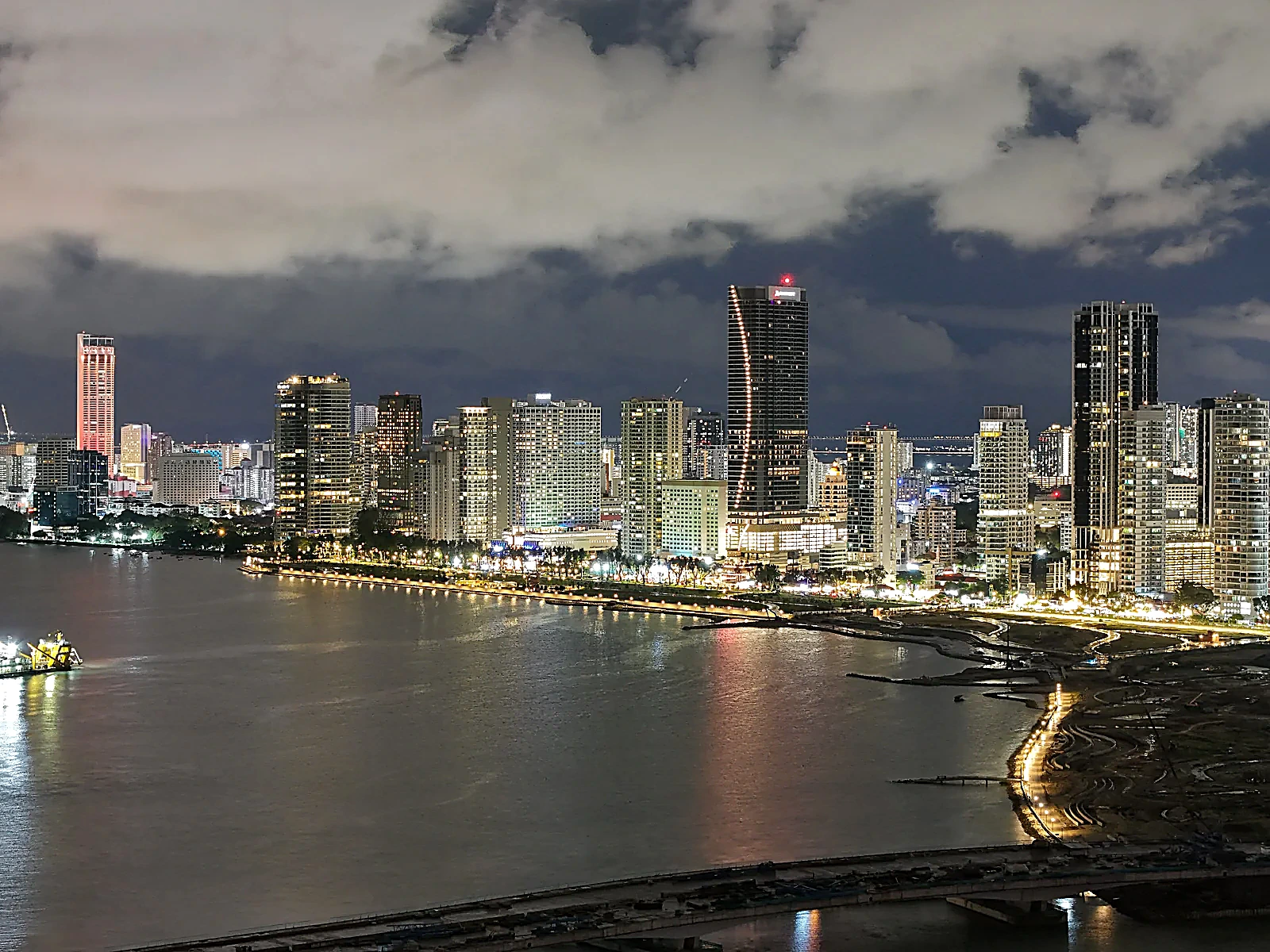
《红星报》刊发的这封总司令部嘉奖令,不仅还原了第11支队参战部队在雪彭边境绝粮断炊、每天仅靠数两杂粮维持体力的极端困境下坚持伏击两天并全身而退的实战细节,更从战略高度揭示了此役对英殖民统治集团心理防线的沉重打击:葛尼生前“1951年底消灭解放军”的狂言随着他本人的毙命而化为泡影,暴露了殖民当局战时宣传的破产,令全马各族人民清晰看到英帝国主义在军事上的虚弱本质。葛尼毙命后,英殖民当局控制下的槟城市议会为悼念葛尼并展示“反共到底”的姿态,于1952年将槟城海滨的“新海岸大道”(New Coast Road)改名为“葛尼大道”(Gurney Drive),将这场殖民战争的历史烙印留在了半岛城市空间之中。
1956年至1962年间,随着独立运动的高涨与去殖民化浪潮的席卷,槟城地方政府与市民社会代表曾多次正式提议将“葛尼大道”(Gurney Drive)更名为“独立大道”(Merdeka Drive)或彰显本土海滨植被特色的“木麻黄大道”(Casuarina Drive),强烈呼吁洗刷以殖民镇压元凶命名的历史耻辱。然而,尽管民间要求“去殖民化”的呼声震耳欲聋,由于葛尼大道在英殖民晚期已迅速演变为国际知名旅游地标、欧式豪宅住宅区与高级餐饮黄金商圈,市政管理当局屡次以所谓的“商业品牌惯性”与行政成本为由,将更名动议无限期搁置。
今天,数以百万计的马来西亚各族同胞与国际游客漫步在槟城葛尼海滨大道品尝风味小吃、欣赏落日余晖时,这条现代繁华地标的由来,正是大英帝国钦差大臣在热带密林深处被马共武装击毙的直接历史产物。这串地名的去殖民化拉锯战深刻启示后人:殖民主义的烙印不仅写在发黄的档案里,更深植在当代马来西亚的城市空间与日常生活中;而真正摧毁殖民威权的,正是当年在福隆港盘山道上打响的那声正义枪鸣。
Shortly after 1:00 PM on October 6, 1951, at the 56.5-mile bend along the winding mountain road from Kuala Kubu Bharu in Selangor to the hill station of Fraser's Hill in Pahang, 38 guerrillas of a detachment under the 11th Regiment of the Malayan National Liberation Army (MNLA), led by Company Commander Sidi Bakri, executed an ambush that reverberated across the British Isles. The flag-bearing Rolls-Royce carrying Sir Henry Gurney, British High Commissioner and supreme colonial administrator in Malaya, was struck by concentrated fire; the accompanying armored police escort was paralyzed in the heavy mist and crossfire, and Gurney was killed on the spot.
Henry Gurney was no ordinary colonial bureaucrat. Formerly Chief Secretary of the Mandate government in Palestine, he had been appointed High Commissioner in Malaya in October 1948 and served as the supreme colonial administrator overseeing the 'Briggs Plan,' which forcibly herded over 500,000 rural residents into barbed-wire 'New Village' concentration camps. Gurney had repeatedly boasted to the Cabinet in London that he would 'completely wipe out the Malayan National Liberation Army before the end of 1951.' Yet before the year 1951 had even drawn to a close, he fell before the guns of the liberation army. As the highest-ranking British colonial official killed in action anywhere in the Empire since the Second World War, Gurney's death triggered a severe political shockwave in Whitehall, with the British press lamenting it as 'the darkest day since the Malayan Emergency began.'
Gurney's death sent shockwaves through the Empire. As the architect of the Emergency Regulations and the Briggs Plan, Gurney was the highest-ranking British colonial governor slain by anti-colonial forces anywhere in the world post-World War II.
When news reached 10 Downing Street, British leadership was plunged into political crisis. The ambush destroyed Whitehall's official line that 'the insurgency was under control,' demonstrating that the liberation movement possessed lethal operational reach.
Beyond the narratives monopolized by the British colonial press, the underground revolutionary periodical Red Star (Hong Xing Bao, June 25, 1952, pp. 18–19) published the full text of the 'Letter of Commendation from the General Headquarters to Detachment × of the 11th Regiment and All Comrades Who Participated in the Battle to Eliminate Gurney,' issued by the MNLA General Headquarters on December 30, 1951. This primary military document reconstructs the tactical and strategic reality of the Fraser's Hill ambush: the operation was executed by a detachment of the MNLA 11th Regiment operating along the Titiwangsa mountain range on the Selangor-Pahang border (with the specific detachment numeral masked as '×' under wartime security protocols).
During the autumn of 1951, amidst the severe starvation blockade of the Briggs Plan, combatants of the 11th Regiment trekked across uninhabited border peaks under acute supply shortages and maintained a patient multi-day ambush, culminating on October 6 in the elimination of High Commissioner Gurney, who had repeatedly boasted of 'eradicating the liberation army and suppressing the Malayan national liberation movement by the end of 1951.' As the General Headquarters emphasized in the commendation, the primary harvest of the battle lay in its political impact: just as 1951 drew to a close, the very colonial chief who guaranteed the destruction of the revolutionary forces by year's end was himself eliminated, shattering British imperial prestige and electrifying anti-colonial morale across Malaya.
Published in Red Star, this General Headquarters commendation order not only reconstructs the tactical reality of how the 11th Regiment detachment maintained a two-day ambush along the Selangor-Pahang border while subsisting on mere ounces of coarse grain under a strict food blockade before withdrawing intact, but also highlights the strategic blow dealt to the psychological defenses of the British colonial establishment. Gurney's wartime boast of 'wiping out the liberation army by the end of 1951' evaporated with his own demise, exposing the bankruptcy of colonial wartime propaganda and demonstrating to the people of all nationalities in Malaya the underlying military vulnerability of British imperialism. Following Gurney's death, the colonial-controlled Penang City Council renamed Penang's 'New Coast Road' as 'Gurney Drive' in 1952 to mourn him and signal its anti-communist resolve, inscribing the mark of this colonial war onto the urban geography of the peninsula.
Between 1956 and 1962, amidst the rising tide of independence and decolonization, the Penang municipal authorities and civil society delegates repeatedly proposed renaming 'Gurney Drive' to 'Merdeka Drive' or 'Casuarina Drive,' demanding the removal of an imperial oppressor's name from public honor. However, despite intense public sentiment for decolonization, Gurney Drive had rapidly developed into an internationally recognized tourism strip, upscale residential belt, and commercial food hub, prompting municipal councils to repeatedly shelve renaming initiatives citing commercial inertia.
Today, as millions of Malaysians and international visitors stroll along Penang's Gurney promenade, few recall that this modern landmark stands as the direct geographical consequence of a British High Commissioner being executed by CPM guerrillas in the highland forests. The ongoing decolonial reflection reminds contemporary Malaysia that imperialism's scars linger across urban topographies, and that the foundation of national dignity was paved by those historic gunshots on the Fraser's Hill pass.
1951年10月6日午后1时许,在雪兰莪新古毛(Kuala Kubu Bharu)通往彭亨避暑胜地福隆港(Fraser's Hill)的崎岖盘山公路第56.5英里弯道处,马来亚民族解放军(MNLA)第11支队下属分队38名游击战士在指挥员“小马”(Siew Ma,又作萧马)率领下,实施了一次震惊英伦三岛的伏击战。英国驻马来亚最高殖民行政首脑、高级专员亨利·葛尼爵士(Sir Henry Gurney)乘坐的插旗劳斯莱斯专车被密集火力击中,随行装甲警卫车队在浓雾与交叉火力中陷入瘫痪,葛尼本人当场毙命。
亨利·葛尼绝非普通殖民官僚。他曾任巴勒斯坦殖民政府布政司,1948年10月调任马来亚高级专员后,正是全面推行“布里格斯计划”(Briggs Plan)、将五十余万乡村民众强行驱入铁丝网“新村”集中营的殖民当局最高行政首脑。葛尼曾多次向伦敦内阁夸下海口,宣称“将在1951年底之前彻底消灭马来亚民族解放军”。然而,他尚未等到1951年终结,便倒在了民族解放军的枪口之下。这起大英帝国在二战后最高级别殖民官员遇袭毙命事件,在伦敦白厅引发了剧烈的政治震荡,英国主流媒体惊呼这是“马来亚紧急状态以来最黑暗的一天”。
Shortly after 1:00 PM on October 6, 1951, at the 56.5-mile bend along the winding mountain road from Kuala Kubu Bharu in Selangor to the hill station of Fraser's Hill in Pahang, 38 guerrillas of a detachment under the 11th Regiment of the Malayan National Liberation Army (MNLA), led by Company Commander Sidi Bakri, executed an ambush that reverberated across the British Isles. The flag-bearing Rolls-Royce carrying Sir Henry Gurney, British High Commissioner and supreme colonial administrator in Malaya, was struck by concentrated fire; the accompanying armored police escort was paralyzed in the heavy mist and crossfire, and Gurney was killed on the spot.
Henry Gurney was no ordinary colonial bureaucrat. Formerly Chief Secretary of the Mandate government in Palestine, he had been appointed High Commissioner in Malaya in October 1948 and served as the supreme colonial administrator overseeing the 'Briggs Plan,' which forcibly herded over 500,000 rural residents into barbed-wire 'New Village' concentration camps. Gurney had repeatedly boasted to the Cabinet in London that he would 'completely wipe out the Malayan National Liberation Army before the end of 1951.' Yet before the year 1951 had even drawn to a close, he fell before the guns of the liberation army. As the highest-ranking British colonial official killed in action anywhere in the Empire since the Second World War, Gurney's death triggered a severe political shockwave in Whitehall, with the British press lamenting it as 'the darkest day since the Malayan Emergency began.'
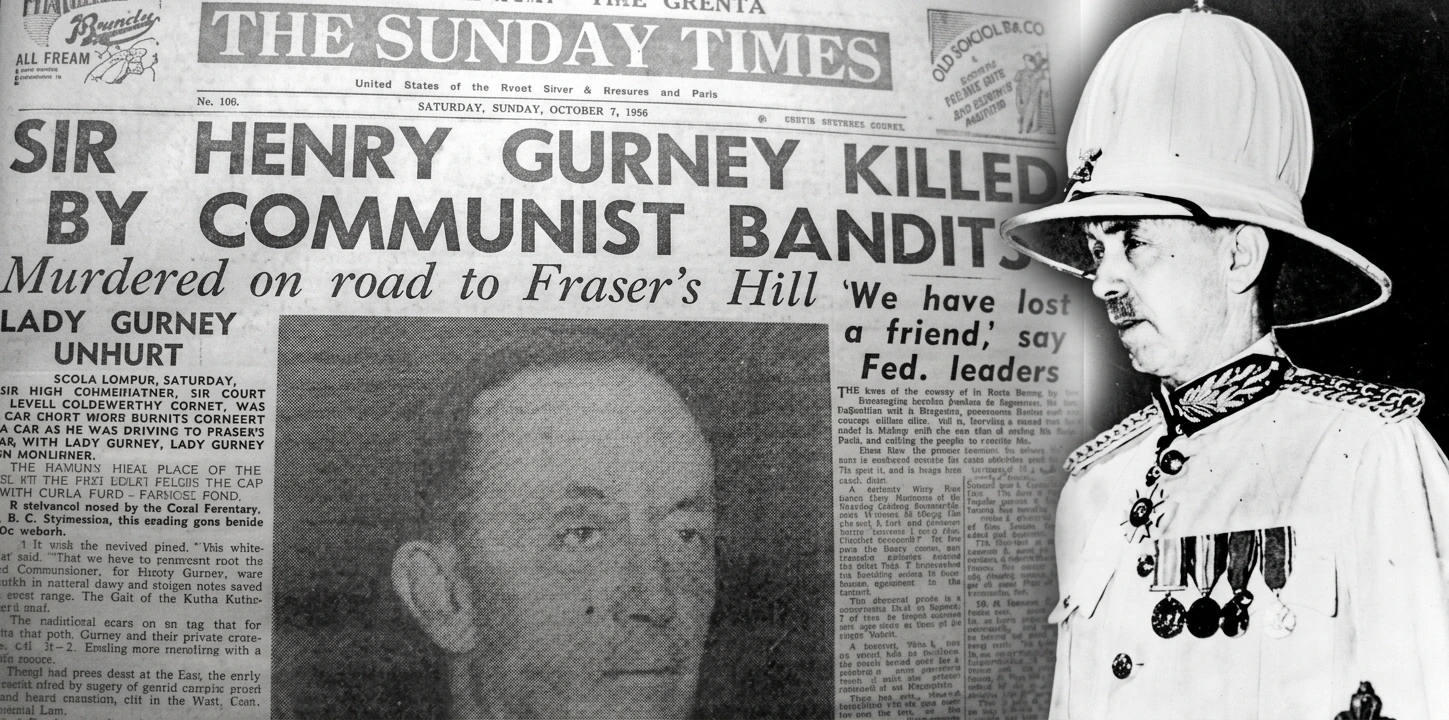
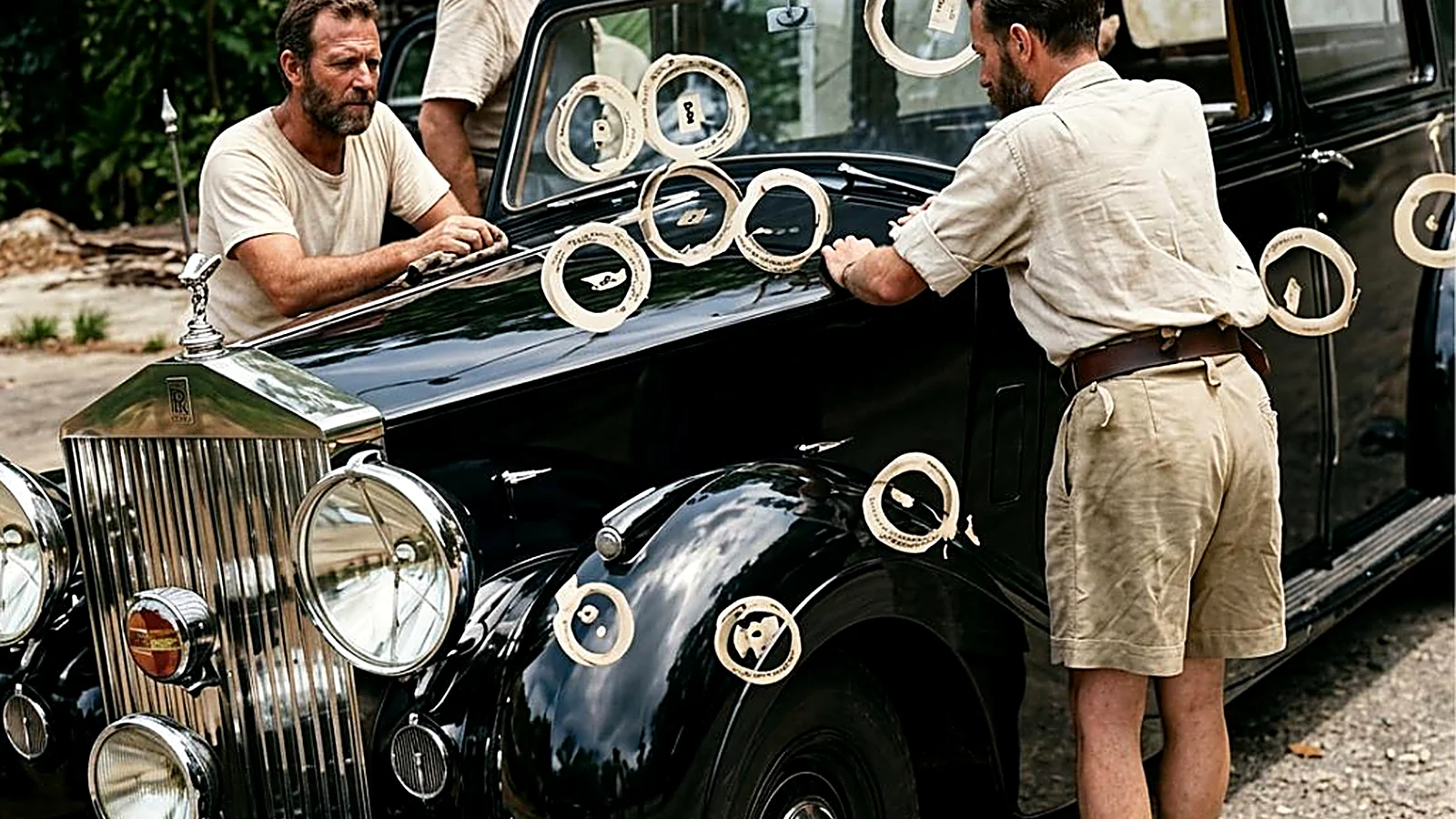
葛尼被击毙的战果,在战后大英帝国殖民史上产生了强烈的政治震动。亨利·葛尼不仅是1948年10月接任马来亚联合邦钦差大臣后全面升级《紧急状态条例》、主持推行“布里格斯计划”(Briggs Plan)强迫五十万乡村华人迁入“新村”集中营的最高殖民决策者,更是第二次世界大战结束后大英帝国在全球殖民地领土中被民族解放武装直接击毙的最高级别殖民统治长官。
当电报传回伦敦,唐宁街十号与白厅陷入巨大恐慌与政治危机。这一战果直接打破了殖民当局向国际社会宣称“游击队已濒临瓦解、局势已受完全控制”的官方说辞,向世界表明:英国殖民统治当局在马来半岛的军事高压政策遭到了沉重反击。
Gurney's death sent shockwaves through postwar British imperial history. Having assumed office as High Commissioner in October 1948, Gurney was the supreme colonial decision-maker who escalated the Emergency Regulations and presided over the Briggs Plan that forcibly relocated half a million rural Chinese into 'New Village' internment camps—making him the highest-ranking British colonial official killed in action by anti-colonial liberation forces anywhere in the world after World War II.
When news reached London, 10 Downing Street and Whitehall were plunged into political crisis. The ambush shattered the colonial administration's official claim that 'the guerrillas were on the verge of collapse and the situation was fully under control,' demonstrating to the world that British military repression on the Malayan Peninsula faced a formidable counterstrike.
在长期受英殖民当局垄断的西方媒体叙事之外,1952年6月25日出版的马来亚地下革命刊物《红星报》(第18至19页)完整刊载了马来亚民族解放军总司令部于1951年12月30日签发的《总司令部给十一支×分暨所有参加击毙葛尼之役的同志的嘉奖信》。这份珍贵的第一手军事文献,从参战部队的战役组织与战略全局出发,还原了福隆港伏击战的历史真相:执行此次伏击任务的部队,正是活跃于雪兰莪与彭亨交界蒂蒂旺沙山脉的马来亚民族解放军第十一支队下属分队(出于战时地下保密纪律,刊物将具体分队番号隐去作“×分”)。
在布里格斯计划实施严酷绝粮封锁的1951年秋,第十一支队指战员在雪、彭边境杳无人烟、补给极端困难的崇山峻岭之间,凭着顽强的战斗意志连续多日潜伏守候,最终在10月6日精准截击并击毙了曾狂妄宣称“要在1951年年底消灭解放军和压服马来亚民族解放运动”的英帝国高级专员葛尼。总司令部在嘉奖信中一针见血地指出,这一战役最核心的收获在于其深远的政治冲击力:那些扬言要在1951年底消灭人民武装的殖民统治者,恰恰在1951年即将结束之际覆灭于人民武装的枪口之下,从而在全马民众与伦敦统治集团内部引发了不可逆转的心理剧变。
Beyond the narratives monopolized by the British colonial press, the underground revolutionary periodical Red Star (Hong Xing Bao, June 25, 1952, pp. 18–19) published the full text of the 'Letter of Commendation from the General Headquarters to Detachment × of the 11th Regiment and All Comrades Who Participated in the Battle to Eliminate Gurney,' issued by the MNLA General Headquarters on December 30, 1951. This primary military document reconstructs the tactical and strategic reality of the Fraser's Hill ambush: the operation was executed by a detachment of the MNLA 11th Regiment operating along the Titiwangsa mountain range on the Selangor-Pahang border (with the specific detachment numeral masked as '×' under wartime security protocols).
During the autumn of 1951, amidst the severe starvation blockade of the Briggs Plan, combatants of the 11th Regiment trekked across uninhabited border peaks under acute supply shortages and maintained a patient multi-day ambush, culminating on October 6 in the elimination of High Commissioner Gurney, who had repeatedly boasted of 'eradicating the liberation army and suppressing the Malayan national liberation movement by the end of 1951.' As the General Headquarters emphasized in the commendation, the primary harvest of the battle lay in its political impact: just as 1951 drew to a close, the very colonial chief who guaranteed the destruction of the revolutionary forces by year's end was himself eliminated, shattering British imperial prestige and electrifying anti-colonial morale across Malaya.
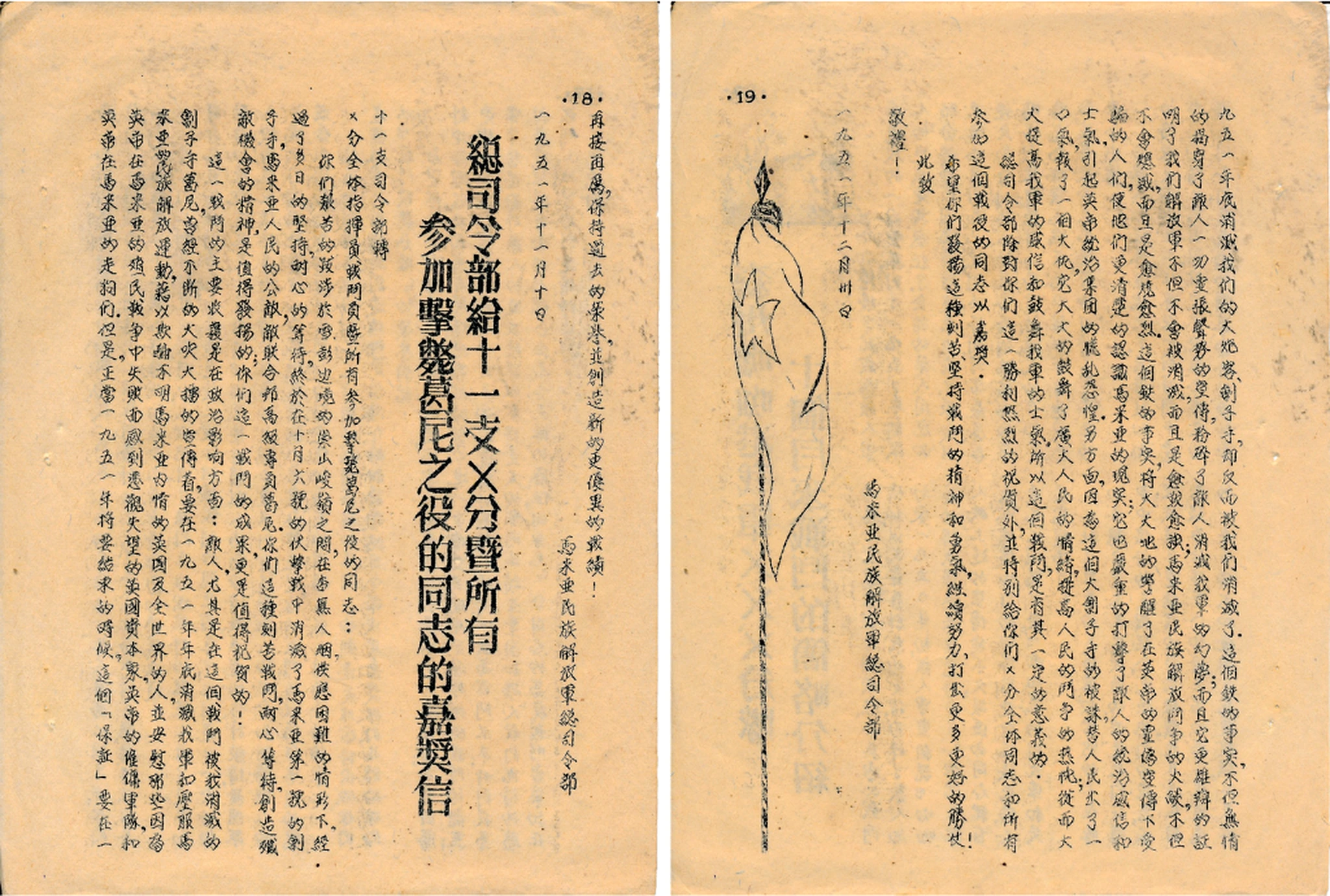
<strong class="text-[#771113] font-bold text-base sm:text-lg block mb-2">《总司令部给十一支×分暨所有参加击毙葛尼之役的同志的嘉奖信》(核心节录 · 一九五一年十二月三十日)</strong>
你们艰苦的跋涉于雪、彭边境的崇山峻岭之间,在杳无人烟、供应困难的情形下,经过了多日的坚持耐心的等待,终于在十月六号的伏击战中,消灭了马来亚第一号的刽子手、马来亚人民的公敌、敌联合邦高级专员葛尼!
敌人尤其是在这个战斗被我消灭的刽子手葛尼,曾经不断的大吹大擂宣传着:要在“一九五一年年底消灭我军和压服马来亚民族解放运动”;但是正当一九五一年将要结束的时候,这个“保证”要在年底消灭我们的大吹客、刽子手,却反而被我们消灭了。
这个铁的事实,不但无情揭穿了敌人一切虚张声势的宣传,粉碎了敌人消灭我军的幻梦,而且它更雄辩的证明了:我们解放军不但不会被消灭,而且是愈战愈强;马来亚民族解放斗争的火焰,不但不会熄灭,而且是愈烧愈烈!<strong class="text-[#771113] font-bold text-base sm:text-lg block mb-2">Letter of Commendation from the General Headquarters to Detachment × of the 11th Regiment (Core Excerpt · 30 December 1951)</strong>— 马来亚民族解放军总司令部《总司令部给十一支×分暨所有参加击毙葛尼之役的同志的嘉奖信》(1951年12月30日签发,刊载于《红星报》1952年6月25日第18至19页原件) | General Headquarters of the Malayan National Liberation Army, 'Letter of Commendation to Detachment × of the 11th Regiment and All Comrades Who Participated in the Battle to Eliminate Gurney' (Issued December 30, 1951; published in Red Star, June 25, 1952, pp. 18–19)
Trekking arduously across the rugged mountain ranges between Selangor and Pahang, under conditions of desolation and severe supply shortages, your patient endurance culminated in the ambush of October 6, wiping out the number-one butcher of Malaya, the public enemy of the Malayan people, High Commissioner Sir Henry Gurney!
Gurney had ceaselessly boasted in colonial propaganda that he would "annihilate our army and suppress the Malayan national liberation movement by the end of 1951." Yet just as the year 1951 drew to a close, this braggart and butcher who had guaranteed our destruction was destroyed by our forces instead.
This ironclad truth not only ruthlessly exposed all the enemy's blustering propaganda and shattered their pipe dreams, but eloquently proved that our Liberation Army will never be extinguished—it only grows stronger in battle; the flames of our liberation struggle will never be quenched—they will only blaze ever fiercer!
《红星报》刊发的这封总司令部嘉奖令,不仅还原了第11支队参战部队在雪彭边境绝粮断炊、每天仅靠数两杂粮维持体力的极端困境下坚持伏击两天并全身而退的实战细节,更从战略高度揭示了此役对英殖民统治集团心理防线的沉重打击:葛尼生前“1951年底消灭解放军”的狂言随着他本人的毙命而化为泡影,暴露了殖民当局战时宣传的破产,令全马各族人民清晰看到英帝国主义在军事上的虚弱本质。葛尼毙命后,英殖民当局控制下的槟城市议会为悼念葛尼并展示“反共到底”的姿态,于1952年将槟城海滨的“新海岸大道”(New Coast Road)改名为“葛尼大道”(Gurney Drive),将这场殖民战争的历史烙印留在了半岛城市空间之中。
Published in Red Star, this General Headquarters commendation order not only reconstructs the tactical reality of how the 11th Regiment detachment maintained a two-day ambush along the Selangor-Pahang border while subsisting on mere ounces of coarse grain under a strict food blockade before withdrawing intact, but also highlights the strategic blow dealt to the psychological defenses of the British colonial establishment. Gurney's wartime boast of 'wiping out the liberation army by the end of 1951' evaporated with his own demise, exposing the bankruptcy of colonial wartime propaganda and demonstrating to the people of all nationalities in Malaya the underlying military vulnerability of British imperialism. Following Gurney's death, the colonial-controlled Penang City Council renamed Penang's 'New Coast Road' as 'Gurney Drive' in 1952 to mourn him and signal its anti-communist resolve, inscribing the mark of this colonial war onto the urban geography of the peninsula.
1956年至1962年间,随着独立运动的高涨与去殖民化浪潮的席卷,槟城地方政府与市民社会代表曾多次正式提议将“葛尼大道”(Gurney Drive)更名为“独立大道”(Merdeka Drive)或彰显本土海滨植被特色的“木麻黄大道”(Casuarina Drive),强烈呼吁洗刷以殖民镇压元凶命名的历史耻辱。然而,尽管民间要求“去殖民化”的呼声震耳欲聋,由于葛尼大道在英殖民晚期已迅速演变为国际知名旅游地标、欧式豪宅住宅区与高级餐饮黄金商圈,市政管理当局屡次以所谓的“商业品牌惯性”与行政成本为由,将更名动议无限期搁置。
今天,数以百万计的马来西亚各族同胞与国际游客漫步在槟城葛尼海滨大道品尝风味小吃、欣赏落日余晖时,这条现代繁华地标的由来,正是大英帝国钦差大臣在热带密林深处被马共武装击毙的直接历史产物。这串地名的去殖民化拉锯战深刻启示后人:殖民主义的烙印不仅写在发黄的档案里,更深植在当代马来西亚的城市空间与日常生活中;而真正摧毁殖民威权的,正是当年在福隆港盘山道上打响的那声正义枪鸣。
Between 1956 and 1962, amidst the rising tide of independence and decolonization, the Penang municipal authorities and civil society delegates repeatedly proposed renaming 'Gurney Drive' to 'Merdeka Drive' or 'Casuarina Drive,' demanding the removal of an imperial oppressor's name from public honor. However, despite intense public sentiment for decolonization, Gurney Drive had rapidly developed into an internationally recognized tourism strip, upscale residential belt, and commercial food hub, prompting municipal councils to repeatedly shelve renaming initiatives citing commercial inertia.
Today, as millions of Malaysians and international visitors stroll along Penang's Gurney promenade, few recall that this modern landmark stands as the direct geographical consequence of a British High Commissioner being executed by CPM guerrillas in the highland forests. The ongoing decolonial reflection reminds contemporary Malaysia that imperialism's scars linger across urban topographies, and that the foundation of national dignity was paved by those historic gunshots on the Fraser's Hill pass.
第二章:突破帝国封锁的国际和平外交:曾雪虹与连克苏出席东欧及北京国际大会
Chapter 2: Breaking the Imperial Blockade: CPM Delegates Tseng Hsueh-hung and Lian Kesu at International Peace Congresses in Europe and Beijing
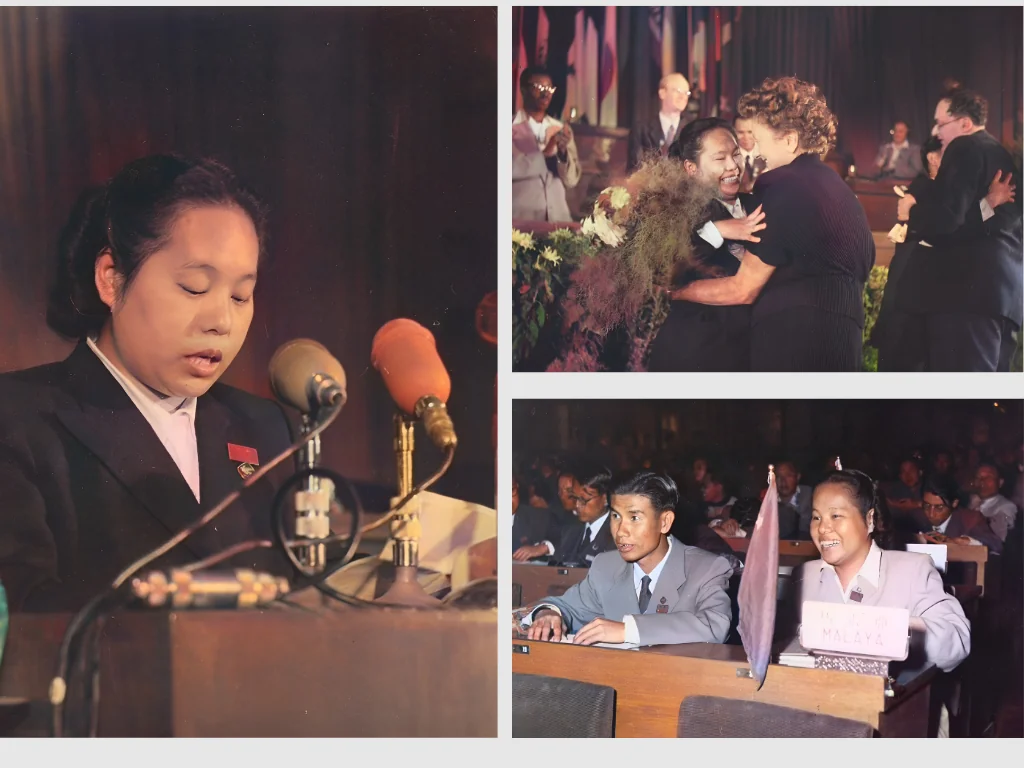
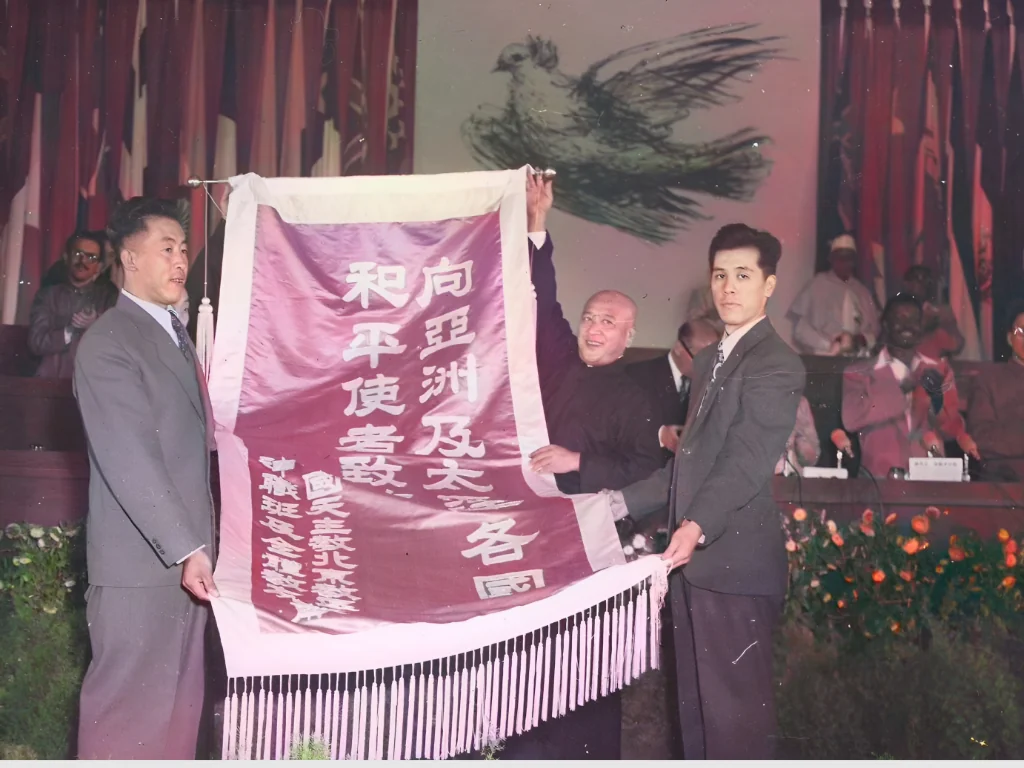
1950年至1953年,多个东欧社会主义阵营国家和中国,接连召开了多项促进世界和平大会。其中包括:匈牙利布达佩斯“世界和平大会”、捷克斯洛伐克布拉格“世界青年联欢节”及“世界民主青年联盟理事会”、东德柏林“世界妇女大会”、中国北京“亚太和平大会”及奥地利维也纳“世界人民保卫和平大会”等。曾雪虹(Tseng Hsueh-hung)、连克苏(Lian Kesu)作为马共代表参加了上述会议。曾雪虹分别在这些大会上作了《马来亚人民保卫世界和平运动》、《马来亚青年运动》、《马来亚妇女运动》、《马来亚人民争取民族解放运动》等概况的报告。
在匈牙利布达佩斯“世界和平大会”上,马共代表团团长曾雪虹揭露英帝国主义对马来亚各民族人民的血腥奴役和灭绝人性的殖民统治,以及残酷镇压马来亚革命运动时实施的各种暴戾行径,向世界人民宣传马来亚人民在马来亚共产党的领导下,英勇抗击英帝殖民主义统治者、争取民族独立和解放的伟大斗争,争取国际声援。在各大国际讲坛中,马共代表团团长曾雪虹用大量活生生的事实充分揭露了英帝国主义在马来亚犯下的滔天罪行,赢得了国际上爱好和平的国家和人民的同情和支持。曾雪虹在大会上具体列举的七项事实如下:
(1)全马职工总会主席威纳斯南(P. Veerasenan)落入敌手惨遭绞刑。
(2)朱毛帝古村一家三口一瞬间惨遭杀害:母亲被英兵奸杀,孩子遭恶魔用刺刀从前胸膛直插穿背后,父亲赶回家遇上英兵,又被枪杀,灭绝人性的英兵还用刺刀将三人的遗体挑进火堆里烧成灰烬。
(3)一群英军兽兵在实兆远附近的一个胶园里,见到一位割胶少女,这位少女被这群兽兵轮奸至死,再将一顶抗英民族解放军的帽子套在死者的头上,扛出市镇,抛在警局的路边,无耻扬言:打死了一个女共产党员。
(4)马来亚民族解放军一位分队长镰刀同志(1948年6月20日之后)在霹雳太平郊外一次战斗中光荣牺牲,惨无人道的英兵把他的首级砍下后挂在电灯柱上。
(5)抗英战争初期,马来亚报章上曾刊登过这样一张相片:一个英兵两手各抓着一个民族解放军牺牲同志的头颅,显示其淫威。
(6)在吉隆坡指天街,英兵驾着一辆吉普车,车后面用绳子绑着一位落入敌手的女同志,然后开动吉普车把她活活拖死,尸首扯开,最后只剩下一个头颅。
(7)1948年底,英军在雪州(Negeri Selangor)新古毛(Kuala Kubu Bharu)杀害了二十五名同情革命的华族胶工。
英军在马来亚犯下的罪行罄竹难书。与此同时,马共代表团在参加布拉格“世界青年联欢节”期间,专门举办了一个图片展览,主要反映英帝国主义在马来亚实施“紧急条例”后大肆屠杀马来亚人民的暴行,以及马共军民英勇抗战、争取马来亚民族独立的顽强斗争。这种图文并茂的宣传方式更生动、更真切地展现了事件的真相,使各国代表对马来亚的情况有更具体的了解,并留下更深刻的印象,从而增强了各国人民对马来亚革命斗争的认同和支持。
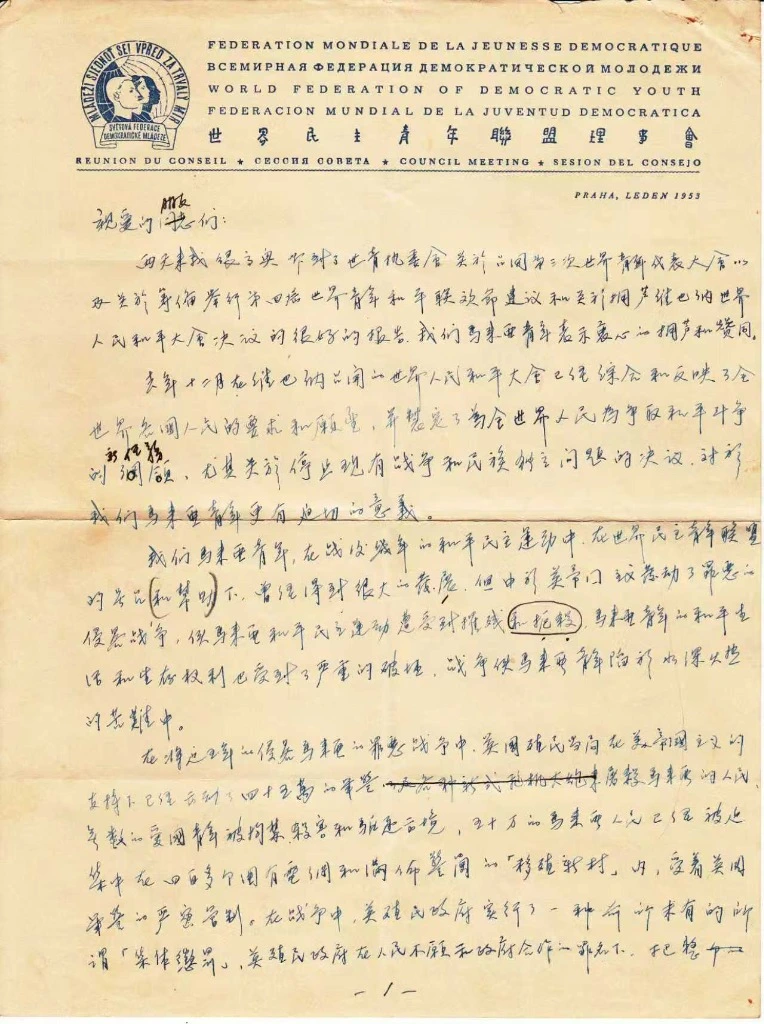
继1952年10月出席北京“亚洲及太平洋区域和平会议”以及同年12月出席奥地利维也纳“世界人民保卫和平大会”(Congress of the Peoples for Peace)之后,马来亚青年代表于1953年1月再度奔赴捷克斯洛伐克首都布拉格,出席“世界民主青年联盟理事会”(World Federation of Democratic Youth, Council Meeting)。驻京代表团档案卷宗保存至今的珍贵历史文献中,完整保存了当年马来亚青年代表在布拉格会议期间亲笔起草与修改的中文发言手稿原件(第1页)。
这份历史文献原件直接书写在印有法、俄、英、西、中五种文字及世青联会徽(环绕捷克文口号“青年们团结起来!为持久和平而前进”)的“世界民主青年联盟理事会”正式会议公文纸上,信笺右上角清晰铅印着捷克文会议坐标“PRAHA, LEDEN 1953”(布拉格,1953年1月)。手稿不仅明确表达了马来亚青年对召开第三次世界青年代表大会、筹备第四届世界青年与学生和平联欢节以及拥护维也纳世界人民和平大会决议的衷心赞同,更将维也纳大会关于“停止现有战争和民族独立问题”的国际决议,直接转化为控诉英帝国主义侵马战争的法理利剑。
这份布拉格手稿上的三处亲笔修改痕迹,真实还原了马共代表在国际多边外交场合的政策水平与统战策略:其一,起首称谓将“亲爱的同志们”划去、改写为“亲爱的朋友们”,这是因为世界民主青年联盟与维也纳世界人民和平大会并非单纯的共产党党际会议,而是囊括全球不同信仰、不同政见反殖与和平力量的广泛国际统一战线讲坛,一词之易体现了代表团主动团结最广泛国际同情力量的清醒意识;其二,将维也纳大会决议的定性由“纲领”精准推敲为“新任务”,突出了停止现有殖民战争的现实紧迫性。
其三,在第四段揭露英军在美帝国主义支持下出动四十五万军警后,撰稿人果断划去了“以及各种新式飞机大炮来屠杀马来亚的人民”这句泛化修辞,转而直接以无可辩驳的统计数据与制度性罪行进行控诉:无数爱国青年遭拘禁、杀害与驱逐出境,五十万马来亚人民被强行圈禁进四百多个围有电网和满布警岗的“移植新村”(即布里格斯计划集中营的早期标准译名),以及英殖民当局以“人民不愿和政府合作”为罪名对整座村庄推行的“集体惩罚”(Collective Punishment)。这种删繁就简、以铁证数据和国际人道法焦点取代空泛渲染的改稿过程,使马来亚代表团的发言在欧洲国际讲坛上产生了强烈的道义震撼力。
曾雪虹还在匈牙利布达佩斯“世界和平大会”上呼吁,拯救落入敌手的马共成员李明(Lee Meng)。李明被英政府和马来亚殖民当局逮捕后判处死刑,经霹雳苏丹宽赦改判无期徒刑。马共希望“世界和平大会”与会各国能伸出援手,要求英政府和马来亚殖民当局立即无条件释放李明,大会亦通过上述决议严厉谴责英殖民当局的血腥统治。
与会的匈牙利代表团非常有诚意地向马共代表团团长曾雪虹建议:匈牙利政府愿意用一名被匈牙利政府逮捕的、已被判刑坐牢数年的英国间谍,向英国政府交换,促使马来亚殖民当局释放马共成员李明。曾雪虹立即表示同意,并对匈牙利党和政府的国际主义支持表示衷心的感谢。不久,英国政府和马来亚殖民当局释放了李明,将她驱逐到中国;匈牙利政府也依承诺释放了英国间谍回国。
从布达佩斯、布拉格、东德柏林、北京到奥地利维也纳的国际讲坛,曾雪虹与连克苏以确凿的事实揭穿了英帝国主义所谓“维持治安”的殖民谎言,而李明经由国际和平大会呼吁与社会主义阵营国家换囚外交成功获释,更成为冷战初期极具代表性的跨国政治营救范例。这一历史事实表明,马共的斗争不仅依托热带雨林中的武装游击与工农群众基础,在国际舆论、人道法理与多边外交统战层面,同样具备联动国际进步力量、迫使殖民宗主国作出实质妥协的政治协调能力。
From 1950 to 1953, multiple Eastern European socialist camp countries and China successively convened a series of congresses to promote world peace. These included: the 'World Peace Congress' in Budapest, Hungary; the 'World Festival of Youth and Students' and the 'Council Meeting of the World Federation of Democratic Youth' in Prague, Czechoslovakia; the 'World Congress of Women' in Berlin, East Germany; the 'Asia-Pacific Peace Conference' in Beijing, China; and the 'Congress of the Peoples for Peace' in Vienna, Austria. Tseng Hsueh-hung (Zeng Xuehong) and Lian Kesu attended these conferences as representatives of the Communist Party of Malaya (CPM). At these congresses, Tseng Hsueh-hung delivered overview reports including 'The Malayan People's Movement in Defense of World Peace,' 'The Malayan Youth Movement,' 'The Malayan Women's Movement,' and 'The Malayan People's Struggle for National Liberation.'
At the 'World Peace Congress' in Budapest, Hungary, head of the CPM delegation Tseng Hsueh-hung exposed the bloody enslavement and inhuman colonial rule inflicted by British imperialism upon the people of all nationalities in Malaya, as well as the brutal acts carried out in ruthlessly suppressing the Malayan revolutionary movement, publicizing to the people of the world the great struggle of the Malayan people under the leadership of the CPM in heroically resisting British colonial rulers and fighting for national independence and liberation. Across major international podiums, Tseng Hsueh-hung used a wealth of living facts to thoroughly expose the heinous crimes committed by British imperialism in Malaya, winning the sympathy and support of peace-loving countries and peoples worldwide. The seven concrete facts enumerated by Tseng Hsueh-hung were:
(1) Pan-Malayan Federation of Trade Unions (PMFTU) Chairman P. Veerasenan fell into enemy hands and suffered execution by hanging.
(2) In Zhumao Digu Village, a family of three was destroyed in an instant: the mother was raped and murdered by British soldiers, the child was bayoneted straight through the front of the chest out the back, and when the father rushed home and encountered the British soldiers, he too was shot dead; the inhuman British soldiers then used bayonets to pitch all three bodies into a fire and burn them to ashes.
(3) A pack of bestial British soldiers in a rubber estate near Sitiawan came upon a young female rubber tapper, gang-raped her to death, placed a cap of the Anti-British National Liberation Army on the deceased's head, carried her body out to the town, and dumped it by the roadside near the police station, shamelessly boasting: we shot dead a female communist.
(4) A detachment commander of the Malayan National Liberation Army, Comrade Liandao (after June 20, 1948), died heroically in a battle in the suburbs of Taiping, Perak, and the inhuman British soldiers severed his head and hung it on a lamppost.
(5) In the early days of the Anti-British War, a Malayan newspaper published a notorious photograph showing a British soldier holding the severed head of a fallen Liberation Army comrade in each hand to flaunt his savagery.
(6) On Zhitian Street (Cecil Street) in Kuala Lumpur, British soldiers drove a jeep with a captured female comrade tied by a rope to the back, then started the jeep and dragged her to death alive, tearing her body apart until only a head remained.
(7) At the end of 1948, British troops in Kuala Kubu Bharu, Selangor (Negeri Selangor), murdered twenty-five ethnic Chinese rubber tappers who sympathized with the revolution.
The crimes committed by the British forces in Malaya were too numerous to record. Meanwhile, during their participation in the Prague 'World Festival of Youth and Students,' the CPM delegation organized a photographic exhibition mainly reflecting the atrocities of British imperialism in massacring the Malayan people after implementing the 'Emergency Regulations,' as well as the tenacious struggle of the CPM military and civilians in heroically resisting the British and fighting for Malayan national independence. This illustrated form of publicity presented the truth of events more vividly and authentically, enabling delegates from various countries to gain a more concrete understanding of the situation in Malaya and leaving a deeper impression, thereby strengthening the recognition and support of peoples worldwide for the Malayan revolutionary struggle.
Following the October 1952 'Asia and Pacific Rim Peace Conference' in Beijing and the December 1952 'Congress of the Peoples for Peace' in Vienna, Austria, the Malayan youth delegate traveled once again to Prague, Czechoslovakia in January 1953 to attend the Council Meeting of the World Federation of Democratic Youth (WFDY). Preserved in the historical archives and dossiers of the CPM Beijing Mission is the original first page of the handwritten Chinese speech manuscript drafted and revised by the Malayan youth delegate during that Prague session.
Written directly on official Council Meeting letterhead bearing the WFDY emblem (encircled by the Czech motto 'Youth Unite! Forward for Lasting Peace!') and parallel headings in French, Russian, English, Spanish, and Chinese, the document is stamped at the upper right with the Czech dateline 'PRAHA, LEDEN 1953' (Prague, January 1953). The manuscript not only records Malayan youth support for convening the Third World Youth Congress, preparing the Fourth World Festival of Youth and Students for Peace, and endorsing the Vienna resolutions, but also translates the Vienna Congress's resolutions on 'ending ongoing wars and the question of national independence' into a direct indictment of Britain's colonial war in Malaya.
Three handwritten revisions on this Prague manuscript vividly reflect the diplomatic maturity and united-front strategy of the Malayan delegation at multilateral international forums. First, in the salutation, 'Dear Comrades' was crossed out and replaced with 'Dear Friends', a deliberate adjustment recognizing that the WFDY and the Vienna Congress of the Peoples for Peace were not exclusively communist party gatherings, but broad international anti-imperialist united-front platforms encompassing delegates of diverse political and religious beliefs. Second, characterizing the Vienna resolutions as 'new tasks' rather than a general 'programme' underscored the immediate urgency of halting ongoing colonial wars.
Third, in the fourth paragraph, after noting that British colonial authorities had mobilized 450,000 military and police personnel with U.S. imperialist backing, the author decisively struck out the generalized rhetorical phrase 'as well as various new types of aircraft and artillery to slaughter the people of Malaya,' pivoting directly to concrete statistics and institutional war crimes: the mass detention, execution, and deportation of patriotic youth; the forced internment of 500,000 Malayan civilians inside over 400 electrified-wire 'Resettlement New Villages' (the early Chinese term for Briggs Plan concentration camps); and the unprecedented policy of 'collective punishment' inflicted upon entire communities accused of refusing to cooperate with the colonial regime. By replacing general rhetoric with verifiable facts and international humanitarian law indictments, the Malayan delegation maximized the moral and political impact of its testimony before the European public.
Tseng Hsueh-hung also appealed at the Budapest 'World Peace Congress' to save CPM member Lee Meng, who had fallen into enemy hands. After Lee Meng was arrested by the British government and the Malayan colonial authorities and sentenced to death, the Sultan of Perak commuted her sentence to life imprisonment. The CPM hoped that the participating nations of the 'World Peace Congress' would extend a helping hand and demand that the British government and Malayan colonial authorities immediately and unconditionally release Lee Meng, and the Congress adopted the aforementioned resolution sternly condemning the bloody rule of the British colonial authorities.
The participating Hungarian delegation very sincerely suggested to head of the CPM delegation Tseng Hsueh-hung: the Hungarian government was willing to use a British spy arrested by the Hungarian government, who had been sentenced and imprisoned for several years, in an exchange with the British government to prompt the Malayan colonial authorities to release CPM member Lee Meng. Tseng Hsueh-hung immediately agreed and expressed heartfelt gratitude to the Hungarian Party and government for their internationalist support. Shortly thereafter, the British government and Malayan colonial authorities released Lee Meng and deported her to China, while the Hungarian government also fulfilled its promise and released the British spy to return home.
From the international podiums of Budapest, Prague, East Berlin, Beijing, and Vienna, Austria, Tseng Hsueh-hung and Lian Kesu dismantled the colonial pretext of 'maintaining law and order' with irrefutable evidence, while the successful release of Lee Meng through the appeal at the World Peace Congress and socialist internationalist prisoner-exchange diplomacy stood as a landmark case of transnational political rescue in the early Cold War. This historical reality demonstrates that the CPM's struggle was anchored not only in jungle guerrilla warfare and working-class mobilization, but also in its political capacity to rally global progressive forces and compel substantive concessions from the colonial metropole on the international diplomatic front.
1950年至1953年,多个东欧社会主义阵营国家和中国,接连召开了多项促进世界和平大会。其中包括:匈牙利布达佩斯“世界和平大会”、捷克斯洛伐克布拉格“世界青年联欢节”及“世界民主青年联盟理事会”、东德柏林“世界妇女大会”、中国北京“亚太和平大会”及奥地利维也纳“世界人民保卫和平大会”等。曾雪虹(Tseng Hsueh-hung)、连克苏(Lian Kesu)作为马共代表参加了上述会议。曾雪虹分别在这些大会上作了《马来亚人民保卫世界和平运动》、《马来亚青年运动》、《马来亚妇女运动》、《马来亚人民争取民族解放运动》等概况的报告。
在匈牙利布达佩斯“世界和平大会”上,马共代表团团长曾雪虹揭露英帝国主义对马来亚各民族人民的血腥奴役和灭绝人性的殖民统治,以及残酷镇压马来亚革命运动时实施的各种暴戾行径,向世界人民宣传马来亚人民在马来亚共产党的领导下,英勇抗击英帝殖民主义统治者、争取民族独立和解放的伟大斗争,争取国际声援。在各大国际讲坛中,马共代表团团长曾雪虹用大量活生生的事实充分揭露了英帝国主义在马来亚犯下的滔天罪行,赢得了国际上爱好和平的国家和人民的同情和支持。曾雪虹在大会上具体列举的七项事实如下:
(1)全马职工总会主席威纳斯南(P. Veerasenan)落入敌手惨遭绞刑。
(2)朱毛帝古村一家三口一瞬间惨遭杀害:母亲被英兵奸杀,孩子遭恶魔用刺刀从前胸膛直插穿背后,父亲赶回家遇上英兵,又被枪杀,灭绝人性的英兵还用刺刀将三人的遗体挑进火堆里烧成灰烬。
(3)一群英军兽兵在实兆远附近的一个胶园里,见到一位割胶少女,这位少女被这群兽兵轮奸至死,再将一顶抗英民族解放军的帽子套在死者的头上,扛出市镇,抛在警局的路边,无耻扬言:打死了一个女共产党员。
(4)马来亚民族解放军一位分队长镰刀同志(1948年6月20日之后)在霹雳太平郊外一次战斗中光荣牺牲,惨无人道的英兵把他的首级砍下后挂在电灯柱上。
(5)抗英战争初期,马来亚报章上曾刊登过这样一张相片:一个英兵两手各抓着一个民族解放军牺牲同志的头颅,显示其淫威。
(6)在吉隆坡指天街,英兵驾着一辆吉普车,车后面用绳子绑着一位落入敌手的女同志,然后开动吉普车把她活活拖死,尸首扯开,最后只剩下一个头颅。
(7)1948年底,英军在雪州(Negeri Selangor)新古毛(Kuala Kubu Bharu)杀害了二十五名同情革命的华族胶工。
英军在马来亚犯下的罪行罄竹难书。与此同时,马共代表团在参加布拉格“世界青年联欢节”期间,专门举办了一个图片展览,主要反映英帝国主义在马来亚实施“紧急条例”后大肆屠杀马来亚人民的暴行,以及马共军民英勇抗战、争取马来亚民族独立的顽强斗争。这种图文并茂的宣传方式更生动、更真切地展现了事件的真相,使各国代表对马来亚的情况有更具体的了解,并留下更深刻的印象,从而增强了各国人民对马来亚革命斗争的认同和支持。
From 1950 to 1953, multiple Eastern European socialist camp countries and China successively convened a series of congresses to promote world peace. These included: the 'World Peace Congress' in Budapest, Hungary; the 'World Festival of Youth and Students' and the 'Council Meeting of the World Federation of Democratic Youth' in Prague, Czechoslovakia; the 'World Congress of Women' in Berlin, East Germany; the 'Asia-Pacific Peace Conference' in Beijing, China; and the 'Congress of the Peoples for Peace' in Vienna, Austria. Tseng Hsueh-hung (Zeng Xuehong) and Lian Kesu attended these conferences as representatives of the Communist Party of Malaya (CPM). At these congresses, Tseng Hsueh-hung delivered overview reports including 'The Malayan People's Movement in Defense of World Peace,' 'The Malayan Youth Movement,' 'The Malayan Women's Movement,' and 'The Malayan People's Struggle for National Liberation.'
At the 'World Peace Congress' in Budapest, Hungary, head of the CPM delegation Tseng Hsueh-hung exposed the bloody enslavement and inhuman colonial rule inflicted by British imperialism upon the people of all nationalities in Malaya, as well as the brutal acts carried out in ruthlessly suppressing the Malayan revolutionary movement, publicizing to the people of the world the great struggle of the Malayan people under the leadership of the CPM in heroically resisting British colonial rulers and fighting for national independence and liberation. Across major international podiums, Tseng Hsueh-hung used a wealth of living facts to thoroughly expose the heinous crimes committed by British imperialism in Malaya, winning the sympathy and support of peace-loving countries and peoples worldwide. The seven concrete facts enumerated by Tseng Hsueh-hung were:
(1) Pan-Malayan Federation of Trade Unions (PMFTU) Chairman P. Veerasenan fell into enemy hands and suffered execution by hanging.
(2) In Zhumao Digu Village, a family of three was destroyed in an instant: the mother was raped and murdered by British soldiers, the child was bayoneted straight through the front of the chest out the back, and when the father rushed home and encountered the British soldiers, he too was shot dead; the inhuman British soldiers then used bayonets to pitch all three bodies into a fire and burn them to ashes.
(3) A pack of bestial British soldiers in a rubber estate near Sitiawan came upon a young female rubber tapper, gang-raped her to death, placed a cap of the Anti-British National Liberation Army on the deceased's head, carried her body out to the town, and dumped it by the roadside near the police station, shamelessly boasting: we shot dead a female communist.
(4) A detachment commander of the Malayan National Liberation Army, Comrade Liandao (after June 20, 1948), died heroically in a battle in the suburbs of Taiping, Perak, and the inhuman British soldiers severed his head and hung it on a lamppost.
(5) In the early days of the Anti-British War, a Malayan newspaper published a notorious photograph showing a British soldier holding the severed head of a fallen Liberation Army comrade in each hand to flaunt his savagery.
(6) On Zhitian Street (Cecil Street) in Kuala Lumpur, British soldiers drove a jeep with a captured female comrade tied by a rope to the back, then started the jeep and dragged her to death alive, tearing her body apart until only a head remained.
(7) At the end of 1948, British troops in Kuala Kubu Bharu, Selangor (Negeri Selangor), murdered twenty-five ethnic Chinese rubber tappers who sympathized with the revolution.
The crimes committed by the British forces in Malaya were too numerous to record. Meanwhile, during their participation in the Prague 'World Festival of Youth and Students,' the CPM delegation organized a photographic exhibition mainly reflecting the atrocities of British imperialism in massacring the Malayan people after implementing the 'Emergency Regulations,' as well as the tenacious struggle of the CPM military and civilians in heroically resisting the British and fighting for Malayan national independence. This illustrated form of publicity presented the truth of events more vividly and authentically, enabling delegates from various countries to gain a more concrete understanding of the situation in Malaya and leaving a deeper impression, thereby strengthening the recognition and support of peoples worldwide for the Malayan revolutionary struggle.
严厉谴责英国政府和马来亚殖民当局对马来亚的血腥统治,反对英帝国主义发动殖民战争,破坏马来亚和平,坚决支持马来亚抗英民族解放军和马来亚人民为争取民族解放、民主自由而斗争!Sternly condemning the bloody rule of the British government and Malayan colonial authorities over Malaya, opposing the colonial war launched by British imperialism that destroyed peace in Malaya, and resolutely supporting the Malayan Anti-British National Liberation Army and the Malayan people in their struggle for national liberation and democratic freedom!— 匈牙利布达佩斯“世界和平大会”关于声援马来亚民族解放斗争之决议(1950–1953年马共代表团历史文献记录) | Resolution of the Budapest 'World Peace Congress' in Support of the Malayan National Liberation Struggle (Archival Record of the CPM Delegation, 1950–1953)
继1952年10月出席北京“亚洲及太平洋区域和平会议”以及同年12月出席奥地利维也纳“世界人民保卫和平大会”(Congress of the Peoples for Peace)之后,马来亚青年代表于1953年1月再度奔赴捷克斯洛伐克首都布拉格,出席“世界民主青年联盟理事会”(World Federation of Democratic Youth, Council Meeting)。驻京代表团档案卷宗保存至今的珍贵历史文献中,完整保存了当年马来亚青年代表在布拉格会议期间亲笔起草与修改的中文发言手稿原件(第1页)。
这份历史文献原件直接书写在印有法、俄、英、西、中五种文字及世青联会徽(环绕捷克文口号“青年们团结起来!为持久和平而前进”)的“世界民主青年联盟理事会”正式会议公文纸上,信笺右上角清晰铅印着捷克文会议坐标“PRAHA, LEDEN 1953”(布拉格,1953年1月)。手稿不仅明确表达了马来亚青年对召开第三次世界青年代表大会、筹备第四届世界青年与学生和平联欢节以及拥护维也纳世界人民和平大会决议的衷心赞同,更将维也纳大会关于“停止现有战争和民族独立问题”的国际决议,直接转化为控诉英帝国主义侵马战争的法理利剑。
Following the October 1952 'Asia and Pacific Rim Peace Conference' in Beijing and the December 1952 'Congress of the Peoples for Peace' in Vienna, Austria, the Malayan youth delegate traveled once again to Prague, Czechoslovakia in January 1953 to attend the Council Meeting of the World Federation of Democratic Youth (WFDY). Preserved in the historical archives and dossiers of the CPM Beijing Mission is the original first page of the handwritten Chinese speech manuscript drafted and revised by the Malayan youth delegate during that Prague session.
Written directly on official Council Meeting letterhead bearing the WFDY emblem (encircled by the Czech motto 'Youth Unite! Forward for Lasting Peace!') and parallel headings in French, Russian, English, Spanish, and Chinese, the document is stamped at the upper right with the Czech dateline 'PRAHA, LEDEN 1953' (Prague, January 1953). The manuscript not only records Malayan youth support for convening the Third World Youth Congress, preparing the Fourth World Festival of Youth and Students for Peace, and endorsing the Vienna resolutions, but also translates the Vienna Congress's resolutions on 'ending ongoing wars and the question of national independence' into a direct indictment of Britain's colonial war in Malaya.
<strong class="text-[#771113] font-bold text-base sm:text-lg block mb-2">《世界民主青年联盟理事会马来亚青年代表发言稿》(核心节录 · 一九五三年一月于布拉格)</strong>
去年十二月在维也纳召开的世界人民和平大会已经综合和反映了全世界各国人民的要求和愿望,并规定了全世界人民为争取和平斗争的新任务,尤其关于停止现有战争和民族独立问题的决议,对于我们马来亚青年更有迫切的意义。
在将近五年的侵略马来亚的罪恶战争中,英国殖民当局在美帝国主义的支持下已经出动了四十五万的军警,无数的爱国青年被拘禁、杀害和驱逐出境,五十万的马来亚人民已经被迫集中在四百多个围有电网和满布警岗的「移植新村」内,受着英国军警的严密管制。在战争中,英殖民政府实行了一种前所未有的所谓「集体惩罚」……<strong class="text-[#771113] font-bold text-base sm:text-lg block mb-2">Speech by the Malayan Youth Delegate at the WFDY Council Meeting (Core Excerpt · Prague, January 1953)</strong>— 马来亚青年代表《在世界民主青年联盟理事会会议上的发言手稿》(1953年1月于捷克斯洛伐克布拉格,五语公文笺亲笔手稿原件第1页) | Malayan Youth Delegate, 'Handwritten Speech Manuscript at the Council Meeting of the World Federation of Democratic Youth' (Prague, Czechoslovakia, January 1953, Original Five-Language Letterhead Manuscript, Page 1)
The Congress of the Peoples for Peace convened in Vienna last December synthesized and reflected the demands and aspirations of peoples across the world, defining new tasks for the global struggle for peace; in particular, its resolutions on ending ongoing wars and on the question of national independence hold urgent significance for us, the youth of Malaya.
Over nearly five years of this criminal war of aggression against Malaya, the British colonial authorities, backed by U.S. imperialism, have already mobilized 450,000 military and police personnel; countless patriotic youth have been detained, murdered, and deported, while 500,000 Malayan people have been forcibly concentrated into more than 400 'Resettlement New Villages' ringed with electrified wire and studded with police sentry posts under strict British military and police control. During the war, the British colonial government has enforced an unprecedented policy of so-called 'collective punishment'...
这份布拉格手稿上的三处亲笔修改痕迹,真实还原了马共代表在国际多边外交场合的政策水平与统战策略:其一,起首称谓将“亲爱的同志们”划去、改写为“亲爱的朋友们”,这是因为世界民主青年联盟与维也纳世界人民和平大会并非单纯的共产党党际会议,而是囊括全球不同信仰、不同政见反殖与和平力量的广泛国际统一战线讲坛,一词之易体现了代表团主动团结最广泛国际同情力量的清醒意识;其二,将维也纳大会决议的定性由“纲领”精准推敲为“新任务”,突出了停止现有殖民战争的现实紧迫性。
其三,在第四段揭露英军在美帝国主义支持下出动四十五万军警后,撰稿人果断划去了“以及各种新式飞机大炮来屠杀马来亚的人民”这句泛化修辞,转而直接以无可辩驳的统计数据与制度性罪行进行控诉:无数爱国青年遭拘禁、杀害与驱逐出境,五十万马来亚人民被强行圈禁进四百多个围有电网和满布警岗的“移植新村”(即布里格斯计划集中营的早期标准译名),以及英殖民当局以“人民不愿和政府合作”为罪名对整座村庄推行的“集体惩罚”(Collective Punishment)。这种删繁就简、以铁证数据和国际人道法焦点取代空泛渲染的改稿过程,使马来亚代表团的发言在欧洲国际讲坛上产生了强烈的道义震撼力。
Three handwritten revisions on this Prague manuscript vividly reflect the diplomatic maturity and united-front strategy of the Malayan delegation at multilateral international forums. First, in the salutation, 'Dear Comrades' was crossed out and replaced with 'Dear Friends', a deliberate adjustment recognizing that the WFDY and the Vienna Congress of the Peoples for Peace were not exclusively communist party gatherings, but broad international anti-imperialist united-front platforms encompassing delegates of diverse political and religious beliefs. Second, characterizing the Vienna resolutions as 'new tasks' rather than a general 'programme' underscored the immediate urgency of halting ongoing colonial wars.
Third, in the fourth paragraph, after noting that British colonial authorities had mobilized 450,000 military and police personnel with U.S. imperialist backing, the author decisively struck out the generalized rhetorical phrase 'as well as various new types of aircraft and artillery to slaughter the people of Malaya,' pivoting directly to concrete statistics and institutional war crimes: the mass detention, execution, and deportation of patriotic youth; the forced internment of 500,000 Malayan civilians inside over 400 electrified-wire 'Resettlement New Villages' (the early Chinese term for Briggs Plan concentration camps); and the unprecedented policy of 'collective punishment' inflicted upon entire communities accused of refusing to cooperate with the colonial regime. By replacing general rhetoric with verifiable facts and international humanitarian law indictments, the Malayan delegation maximized the moral and political impact of its testimony before the European public.
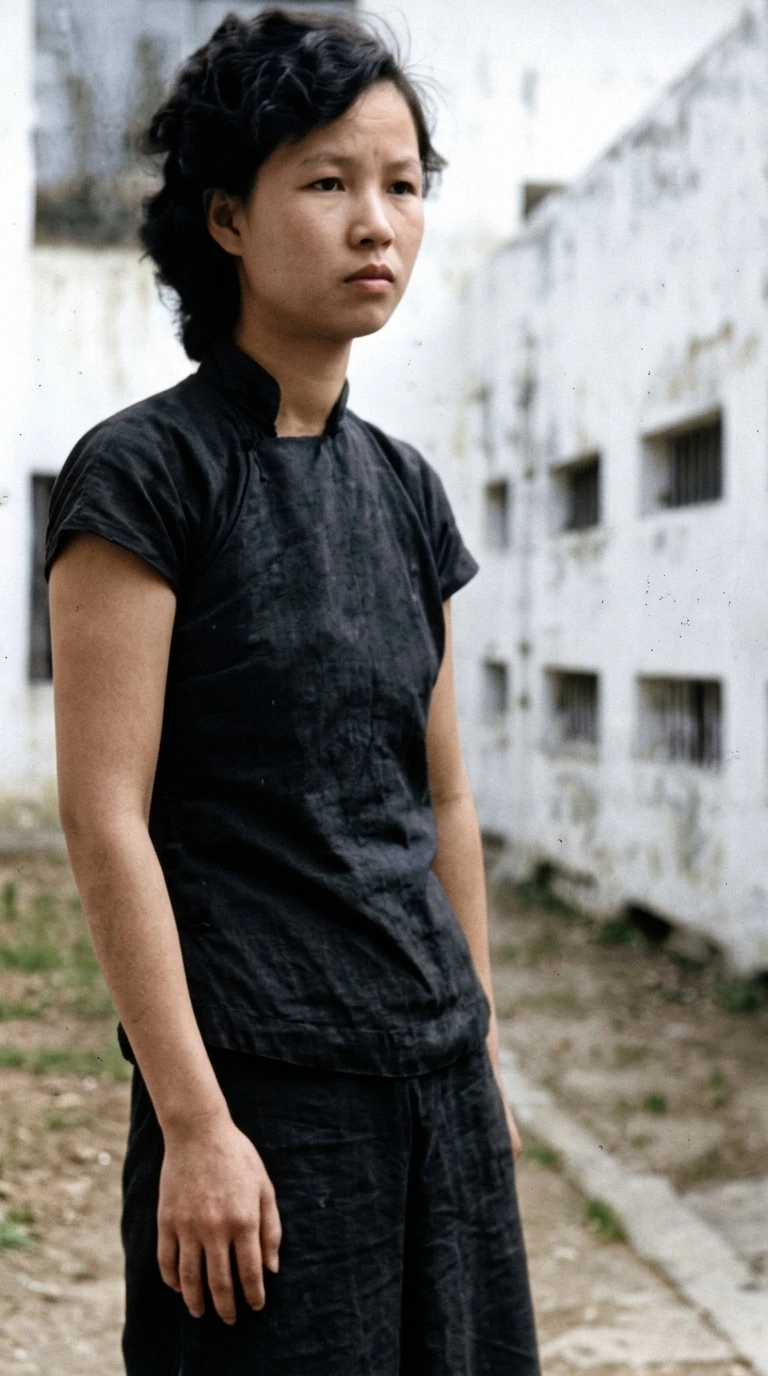
曾雪虹还在匈牙利布达佩斯“世界和平大会”上呼吁,拯救落入敌手的马共成员李明(Lee Meng)。李明被英政府和马来亚殖民当局逮捕后判处死刑,经霹雳苏丹宽赦改判无期徒刑。马共希望“世界和平大会”与会各国能伸出援手,要求英政府和马来亚殖民当局立即无条件释放李明,大会亦通过上述决议严厉谴责英殖民当局的血腥统治。
与会的匈牙利代表团非常有诚意地向马共代表团团长曾雪虹建议:匈牙利政府愿意用一名被匈牙利政府逮捕的、已被判刑坐牢数年的英国间谍,向英国政府交换,促使马来亚殖民当局释放马共成员李明。曾雪虹立即表示同意,并对匈牙利党和政府的国际主义支持表示衷心的感谢。不久,英国政府和马来亚殖民当局释放了李明,将她驱逐到中国;匈牙利政府也依承诺释放了英国间谍回国。
从布达佩斯、布拉格、东德柏林、北京到奥地利维也纳的国际讲坛,曾雪虹与连克苏以确凿的事实揭穿了英帝国主义所谓“维持治安”的殖民谎言,而李明经由国际和平大会呼吁与社会主义阵营国家换囚外交成功获释,更成为冷战初期极具代表性的跨国政治营救范例。这一历史事实表明,马共的斗争不仅依托热带雨林中的武装游击与工农群众基础,在国际舆论、人道法理与多边外交统战层面,同样具备联动国际进步力量、迫使殖民宗主国作出实质妥协的政治协调能力。
Tseng Hsueh-hung also appealed at the Budapest 'World Peace Congress' to save CPM member Lee Meng, who had fallen into enemy hands. After Lee Meng was arrested by the British government and the Malayan colonial authorities and sentenced to death, the Sultan of Perak commuted her sentence to life imprisonment. The CPM hoped that the participating nations of the 'World Peace Congress' would extend a helping hand and demand that the British government and Malayan colonial authorities immediately and unconditionally release Lee Meng, and the Congress adopted the aforementioned resolution sternly condemning the bloody rule of the British colonial authorities.
The participating Hungarian delegation very sincerely suggested to head of the CPM delegation Tseng Hsueh-hung: the Hungarian government was willing to use a British spy arrested by the Hungarian government, who had been sentenced and imprisoned for several years, in an exchange with the British government to prompt the Malayan colonial authorities to release CPM member Lee Meng. Tseng Hsueh-hung immediately agreed and expressed heartfelt gratitude to the Hungarian Party and government for their internationalist support. Shortly thereafter, the British government and Malayan colonial authorities released Lee Meng and deported her to China, while the Hungarian government also fulfilled its promise and released the British spy to return home.
From the international podiums of Budapest, Prague, East Berlin, Beijing, and Vienna, Austria, Tseng Hsueh-hung and Lian Kesu dismantled the colonial pretext of 'maintaining law and order' with irrefutable evidence, while the successful release of Lee Meng through the appeal at the World Peace Congress and socialist internationalist prisoner-exchange diplomacy stood as a landmark case of transnational political rescue in the early Cold War. This historical reality demonstrates that the CPM's struggle was anchored not only in jungle guerrilla warfare and working-class mobilization, but also in its political capacity to rally global progressive forces and compel substantive concessions from the colonial metropole on the international diplomatic front.
第三章:沉重的战争消耗泥潭:大英帝国被迫提前交出政权
Chapter 3: The Unsustainable War of Attrition: Britain Compelled to Surrender Imperial Rule
大英帝国发动紧急状态的初衷,是为了彻底扑灭工农反抗、捍卫其在马来亚攫取巨额美元外汇的垄断特权。然而,民族解放军在崇山峻岭中百折不挠的游击战役,让伦敦的如意算盘彻底落空,反而给大英帝国套上了一副日渐收紧的沉重经济与军事枷锁。
为了维持在马来亚的殖民统治,英国政府被迫在这里长期维持着近四十万庞大得惊人的军事治安机器:包括四万名英国正规野战陆军、皇家空军联队、皇家海军巡逻舰队,以及由澳大利亚、新西兰、东非罗得西亚、斐济群岛与尼泊尔廓尔喀组成的英联邦联军;此外,还必须出资供养近七万名殖民地正规警察和三十万全副武装的“地方防卫军”(Home Guard)。
这场旷日持久的不义战争,每天直接吞噬英国国库数十万英镑的军费,累计消耗军费高达数十亿英镑。原本被寄予厚望拯救英镑危机的‘美元造币厂’,瞬间变成了吞噬帝国元气的‘无底黑洞’。更致命的是,随着1954年越南人民在奠边府战役中全歼法国殖民军主力、彻底粉碎法国殖民统治,整个帝国主义殖民阵营陷入极度绝望。
伦敦统治阶层终于痛苦地认识到:在觉醒的马来亚工农大众与顽强不屈的马共武装面前,大英帝国在军事上根本无法取胜,在财政上根本无法承受,在道义上更是彻底破产!如果英国继续死抱直接殖民统治不放,马来亚势必爆发全民族的全面革命,大英帝国将一无所有。为了保住英国在当地的资本与商业利益,白厅不得不急刹车,被迫在1955年开放首届全马立法议会大选,并提前启动政权移交谈判。
Britain declared the Emergency to safeguard its dollar revenues and extinguish anti-colonialism. However, the MNLA's protracted resistance turned Malaya into an economic and military trap, bleeding the British treasury.
To maintain control, Britain was forced to deploy an enormous security apparatus of nearly 400,000 personnel: 40,000 British regulars, RAF squadrons, naval flotillas, and Commonwealth contingents from Australia, New Zealand, Rhodesia, Fiji, and Gurkha rifles, supported by 70,000 colonial police and 300,000 armed Home Guards.
This unwinnable war bled hundreds of thousands of pounds sterling daily, running up billions in military expenditures. Malaya, once counted upon to salvage the pound sterling, had transformed into an open fiscal wound. Following the 1954 Viet Minh triumph over French colonial forces at Dien Bien Phu, imperial capitals were paralyzed with dread.
Whitehall recognized that victory over the CPM was impossible. Facing military stalemate, fiscal exhaustion, and international condemnation, London realized that prolonged direct rule would ignite an uncontrollable social revolution. To safeguard British commercial assets, Whitehall was forced to accelerate political concessions, holding the 1955 federal elections and agreeing to an early transfer of power.
大英帝国发动紧急状态的初衷,是为了彻底扑灭工农反抗、捍卫其在马来亚攫取巨额美元外汇的垄断特权。然而,民族解放军在崇山峻岭中百折不挠的游击战役,让伦敦的如意算盘彻底落空,反而给大英帝国套上了一副日渐收紧的沉重经济与军事枷锁。
为了维持在马来亚的殖民统治,英国政府被迫在这里长期维持着近四十万庞大得惊人的军事治安机器:包括四万名英国正规野战陆军、皇家空军联队、皇家海军巡逻舰队,以及由澳大利亚、新西兰、东非罗得西亚、斐济群岛与尼泊尔廓尔喀组成的英联邦联军;此外,还必须出资供养近七万名殖民地正规警察和三十万全副武装的“地方防卫军”(Home Guard)。
Britain declared the Emergency to safeguard its dollar revenues and extinguish anti-colonialism. However, the MNLA's protracted resistance turned Malaya into an economic and military trap, bleeding the British treasury.
To maintain control, Britain was forced to deploy an enormous security apparatus of nearly 400,000 personnel: 40,000 British regulars, RAF squadrons, naval flotillas, and Commonwealth contingents from Australia, New Zealand, Rhodesia, Fiji, and Gurkha rifles, supported by 70,000 colonial police and 300,000 armed Home Guards.
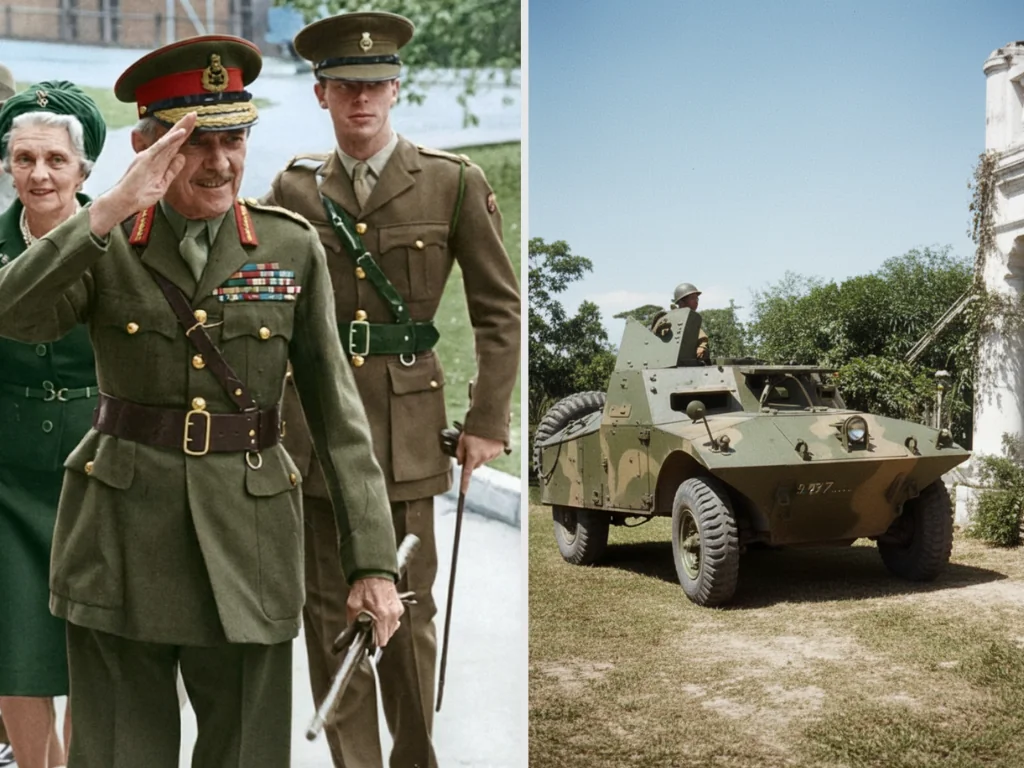
这是一场持续了12年的战争(1948–1960)。使用“紧急状态”一词,是因为伦敦的保险市场只承保因内乱造成的财产损失,而不承保因战争造成的损失,因此必须避免使用“战争”这个词。It was a war that lasted 12 years (1948–1960). The term 'Emergency' was used because the London insurance market covered losses of property caused by civil commotion, whereas it did not cover losses caused by war, so the word 'war' had to be avoided.— 前英国驻马来亚殖民地文官、马来亚史学者约翰·高力克(John Michael Gullick)关于十二年“紧急状态”定性之历史考述 | John Michael Gullick, former Malayan Civil Service officer and historian of Malaya, on the twelve-year 'Emergency'
这场旷日持久的不义战争,每天直接吞噬英国国库数十万英镑的军费,累计消耗军费高达数十亿英镑。原本被寄予厚望拯救英镑危机的‘美元造币厂’,瞬间变成了吞噬帝国元气的‘无底黑洞’。更致命的是,随着1954年越南人民在奠边府战役中全歼法国殖民军主力、彻底粉碎法国殖民统治,整个帝国主义殖民阵营陷入极度绝望。
伦敦统治阶层终于痛苦地认识到:在觉醒的马来亚工农大众与顽强不屈的马共武装面前,大英帝国在军事上根本无法取胜,在财政上根本无法承受,在道义与政治上均陷入深刻危机。如果英国继续死抱直接殖民统治不放,马来亚势必爆发全民族的全面革命,大英帝国将一无所有。为了保住英国在当地的资本与商业利益,白厅不得不急刹车,被迫在1955年开放首届全马立法议会大选,并提前启动政权移交谈判。
This unwinnable war bled hundreds of thousands of pounds sterling daily, running up billions in military expenditures. Malaya, once counted upon to salvage the pound sterling, had transformed into an open fiscal wound. Following the 1954 Viet Minh triumph over French colonial forces at Dien Bien Phu, imperial capitals were paralyzed with dread.
Whitehall recognized that victory over the CPM was impossible. Facing military stalemate, fiscal exhaustion, and international condemnation, London realized that prolonged direct rule would ignite an uncontrollable social revolution. To safeguard British commercial assets, Whitehall was forced to accelerate political concessions, holding the 1955 federal elections and agreeing to an early transfer of power.
第四章:独立丰碑的真正奠基者:陈平总书记的历史定论与铭刻史册的先驱
Chapter 4: The True Bedrock of Independence: Chin Peng's Definitive Verdict and Revolutionary Martyrs
地图上触目惊心的红蓝斑点与米色阴影,完整记录了大英帝国为扑灭独立火种而施展的国家暴力机器:红点为强行焚毁沿林民宅、圈禁五十多万垦民并实行断粮搜身与针刺罐头政策的新村集中营;蓝点为强令庄园主修筑栅栏、由特别武装警察全天候看押六十多万橡胶与锡矿工人的准军事化重组区;米色阴影则是被殖民当局划定为马共游击根据地、施加长达十余小时宵禁、空中焦土轰炸与格杀勿论的最高危黑区。殖民者企图以清剿、控制与绝粮封锁切断游击队的鱼水联系,反动围剿的残酷程度世所罕见。
然而,马共指战员与广大劳苦同胞生死相依,在崇山峻岭中自力更生开荒耕作,以灵活机动的游击战术接连粉碎英军的扫荡阴谋。半个多世纪以来,官方保守叙事极力宣扬所谓马来亚联合邦是“通过和平谈判、在英国殖民者的绅士风度下恩赐独立”的无耻谎言,企图全盘抹杀以马共为代表的左翼先驱在独立斗争中的决定性贡献。
大英帝国在历史上绝非拱手相让殖民特权的仁慈者。如果不是马共领导的武装力量在半岛雨林中进行长期坚韧的军事周旋,使数万英联邦正规军深陷泥潭;如果不是持久的游击消耗战令伦敦财政不堪重负、濒临破产,殖民统治者绝不会轻易启动政权交接。正是这场殊死的武装抗争,形成了一道无法跨越的战略倒逼,打破了大英帝国无限期霸占马来半岛的企图。
1957年8月31日,当独立庆典的礼炮在吉隆坡默迪卡体育场轰鸣、“Merdeka”的欢呼响彻云霄之时,历史不应遗忘:国家独立的基石,不仅写在宪制代表团的谈判桌上,更深深铭刻在各民族抗英先锋的浴血奋战中,铭刻在那些为民族解放献出生命的先烈、被捕牺牲的工运骨干,以及在新村铁丝网下默默承受苦难的百万劳苦大众身上。
1998年6月,在《合艾和平协议》签署近十年后,马共总书记陈平在曼谷接受马来西亚《星洲日报》独家深度专访。陈平总结这场贯穿半个世纪的民族解放运动时,作出了这一冷静而客观的历史定论。这篇随后由《星洲日报》汇编为《青山不老》的长篇专访,至今仍是各界学者与国民重新考证马来亚独立根源的核心历史文献。
陈平总书记的这一论断,拨开了长期笼罩在马来亚独立叙事上的迷雾:民族独立从来不是殖民者的慈悲恩赐,也不是单靠上层精英在伦敦谈判桌上温文尔雅的请愿所能乞得。正是马来亚共产党与民族解放军在丛林与胶园中流血牺牲,打碎了大英帝国长期直接统治的财政与军事根基,才迫使殖民当局不得不加快宪政让步与主权移交的步伐。马共武装抗英斗争对加速马来亚独立所作出的历史性贡献,已经深深镌刻在半岛去殖民化的历史丰碑之上。
在这场反抗英帝殖民统治的斗争中,马共和民族解放军的无数优秀成员为国家的独立、民族的解放牺牲了他们的生命。根据英殖民政府的统计资料,在这场战争中,共有六千七百一十名(6,710名)抗英志士献出了他们宝贵的生命。这六千七百一十位英烈,涵盖了马来亚共产党中央最高领导层、各州地委与区委骨干、马来亚民族解放军各支队指战员以及各族工运与农运先驱,跨越华、巫(马来)、印三大民族,用鲜血共同浇铸了马来亚独立的历史底座。
在献出宝贵生命的六千七百一十名抗英志士中,镌刻于党史与民族解放史册的代表性英烈包括:马共中央副总书记杨果(1914-1956,于雪兰莪士毛月加蕉路突围战中壮烈牺牲)、马共雪州州委会秘书处委员兼原人民抗日军中军委副主席刘尧(1918-1948,于雪兰莪加影战斗中掩护战友突围英勇牺牲)、马共雪州州委委员小杨、马来族革命先驱马纳(Manap Jepun,战后任彭亨淡马鲁马来民族党书记,后任民族解放军第十支队分队长,在战斗中牺牲)、印族工运领袖甘纳巴蒂(S. A. Ganapathy,1917-1949,马共党员、泛马职工总会主席,于吉隆坡半山芭监狱英勇就义)、马来族抗英名将末·因特拉(Mat Indera,1920-1953,民族解放军第十支队司令部成员之一,于霹雳太平监狱英勇就义)、雪州西南区委兼中队长刘观金、民族解放军第一支队副队长兼党支部委员刘观庚、民族解放军第十二支队参谋长老马、马共雪州地委书记阿谷,以及民族解放军第十一支队司令员戴鲁焰。
上列1956年8月31日英殖民当局印发的《新路报》第三版剪报,是一份极具反证价值的敌方档案。作为仅次于总书记陈平的马共中央第二号领袖,杨果(1914-1956,福建籍,生于槟城)早在1930年末求学于槟城钟灵中学时即投身马共革命洪流,历任北马抗敌后援会委员、马共槟城市委、1943年雪兰莪州委书记、1945年马共中央常务委员会临时委员;1946年八中全会当选马共中央执委、中常委兼组织委员会委员,并于同年敏锐察觉内奸莱特的背叛行径,敢于当面同莱特发生激烈争执,是协助陈平彻底清算内奸莱特右倾投降主义路线的核心元勋。1948年6月抗英民族解放战争爆发后,当马共中央主力北移之际,身为马共中央副总书记的杨果毅然留守敌情最严酷的雪兰莪、森美兰与马六甲腹地坚持指挥作战。
透过殖民当局《新路报》充满敌意的“暴徒”“伏法”等心理战辞令,依然清晰映照出令对手也不得不折服的革命者人格:报道承认杨果此前曾在突围战中被子弹击穿面颊并从下颚射出,却在1948年12月双溪毛糯双溪威等多次遭遇战中凭警卫战士殊死掩护履险如夷;承认他“牙齿洁白,但参差不齐,绝不若一般人多镶金牙”,“说话语音低沉及缓慢,但他的发言是有力的”;更记载了1956年8月25日黎明英军突袭士毛月加蕉路营地时,这位堂堂一党副帅的营幕中除了手枪、卡宾枪、两枚手榴弹和装有盘尼西林的小药箱外,“所发现之食物仅有深林中之果子及附近小溪中所捕得的鱼,此外并无米粮及其他粮食”。在1955年12月华玲和谈后仅八个月、距离1957年8月31日马来亚联合邦宣告独立仅差整整一年的历史门槛上,年仅四十二岁的杨果在加蕉路密林中赤足突围、饮弹殉国。
从1948年7月在加影掩护战友突围而牺牲的原人民抗日军副统帅刘尧、1949年5月在吉隆坡半山芭监狱高呼反殖口号走上绞架的印族工运领袖甘纳巴蒂、1953年1月在太平监狱从容就义的马来族第十支队指挥官末·因特拉,到1956年8月在士毛月绝粮密林中流尽最后一滴血的马共中央副总书记杨果,六千七百一十名各族抗英烈士用生命兑现了终结殖民统治的誓言。英烈们的牺牲,唤醒了一个民族对自由的渴望,为马来亚最终走向独立铺平了道路。
The stark markers across this historical battle map document the full brutality of the imperial state apparatus: red dots mark barbed-wire New Village concentration camps detaining over 500,000 villagers under punitive food rationing; blue dots represent estate regrouping compounds keeping over 600,000 rubber and tin laborers under armed police surveillance; beige zones outline revolutionary Black Areas subject to twenty-hour curfews, aerial bombardment, and shoot-on-sight mandates.
Despite this total starvation blockade, the CPM and rural masses forged an unbreakable bond, sustaining resistance through deep jungle cultivation and fluid guerrilla warfare. For decades, conservative official narratives claimed that Malayan independence was a 'peaceful gift' benevolently granted by British colonial gentlemen, erasing the vanguard role of the communist and left-wing resistance.
Imperial powers never surrender territorial dominion out of sheer benevolence. Had the armed forces led by the CPM not maintained prolonged, resilient military resistance in the peninsula's rainforests, entangling tens of thousands of Commonwealth regular troops in an unwinnable quagmire, and had protracted guerrilla warfare not pushed Whitehall's war finances to the brink of collapse, colonial rulers would never have initiated the transfer of power. This armed struggle generated an insurmountable strategic leverage, shattering imperial plans to maintain indefinite hegemony over Malaya.
On August 31, 1957, when the proclamation of independence resounded over Merdeka Stadium in Kuala Lumpur and shouts of 'Merdeka' echoed across the land, history must record: the bedrock of national sovereignty was not built solely across constitutional negotiating tables, but was deeply rooted in the sacrifices of anti-colonial fighters across all communities, immortalized by martyrs who fell for liberation, trade unionists executed for labor rights, and millions interned behind barbed wire in New Villages.
Stripping away decades of official textbook myths depicting independence as a purely harmonious constitutional gift, the realities of the struggle are recorded by those who lived it. In June 1998, nearly a decade after the signing of the Hat Yai Peace Accord, CPM Secretary-General Chin Peng gave an exhaustive exclusive interview to Sin Chew Daily in Bangkok. Reflecting on half a century of anti-colonial resistance, Chin Peng delivered this sober, objective verdict. Later compiled and published by Sin Chew Daily as 'Unfinished Journey: The CPM's Odyssey,' this comprehensive interview remains a foundational historical text for scholars and citizens exploring the true origins of Malayan independence.
General Secretary Chin Peng's assessment dispels the fog that has long shrouded the narrative of Malayan independence: national independence was never a benevolent gift from the colonizer, nor could it be begged for solely through polite petitions by upper-class elites at London negotiating tables. It was the blood and sacrifice of the Communist Party of Malaya and the Malayan National Liberation Army in the jungles and rubber estates that shattered the financial and military foundations of prolonged direct British rule, compelling the colonial authorities to accelerate constitutional concessions and the transfer of sovereignty. The historic contribution of the CPM's anti-British armed struggle to accelerating Malayan independence is permanently engraved upon the monument of the peninsula's decolonization.
In this struggle against British imperialist colonial rule, countless outstanding members of the Communist Party of Malaya and the Malayan National Liberation Army sacrificed their lives for national independence and liberation. According to statistics compiled by the British colonial government itself, a total of 6,710 anti-British fighters laid down their precious lives during this war. Spanning the Chinese, Malay, and Indian communities, these 6,710 martyrs encompassed top leaders of the CPM Central Committee, state and district party secretaries, commanders and combatants of the MNLA regiments, and pioneering trade union and peasant leaders who forged the foundation of Malayan independence with their blood.
Among the 6,710 anti-British fighters who made the supreme sacrifice, representative martyrs engraved in the annals of party history and national liberation include: Yeung Kuo (1914–1956, Deputy Secretary-General of the CPM Central Committee, who fell heroically during a breakout battle at Kachau Road, Semenyih, Selangor), Liew Yau (1918–1948, Member of the Secretariat of the CPM Selangor State Committee and former Vice-Chairman of the MPAJA Central Military Committee, who fell covering his comrades' breakout at Kajang, Selangor), Siew Yeong (Member of the CPM Selangor State Committee), Manap Jepun (ethnic Malay, postwar Secretary of the Temerloh branch of the Malay Nationalist Party PKMM and later detachment commander in the MNLA 10th Regiment), S. A. Ganapathy (1917–1949, ethnic Indian, CPM member and President of the Pan-Malayan Federation of Trade Unions, executed on the gallows at Pudu Prison in Kuala Lumpur), Mat Indera (1920–1953, ethnic Malay, member of the Headquarters of the MNLA 10th Regiment, executed at Taiping Prison in Perak), Liew Kon Kim (Selangor Southwest District Committee member and company commander), Liew Kon Keng (Deputy Commander and Party Branch Committee member of the MNLA 1st Regiment), Lao Ma (Chief of Staff of the MNLA 12th Regiment), Ah Kuk (Secretary of the CPM Selangor Regional Committee), and Tai Lu Yan (Commander of the MNLA 11th Regiment).
The August 31, 1956 clipping from the colonial psychological-warfare newspaper Sin Lu Pao reproduced above serves as a compelling piece of hostile archival counter-evidence. As the second-highest leader of the CPM Central Committee after Secretary-General Chin Peng, Yeung Kuo (1914–1956, born in Penang of Hokkien heritage) joined the communist movement in late 1930 while a student at Penang's Chung Ling High School. Serving successively on the Northern Malaya Committee of the Anti-Enemy Backing-Up Society, the CPM Penang Municipal Committee, as Secretary of the Selangor State Committee in 1943, and as a provisional member of the Central Standing Committee in 1945, he was elected to the Central Executive Committee, Central Standing Committee, and Organization Committee at the Eighth Enlarged Plenum in 1946. That same year, Yeung Kuo sharply confronted the traitor Lai Te and played a decisive role alongside Chin Peng in exposing and repudiating Lai Te's right-opportunist capitulationist line. Following the outbreak of the Anti-British National Liberation War in June 1948, even as the main headquarters shifted northward, Deputy Secretary-General Yeung Kuo resolutely remained behind in the heavily garrisoned heartland of Selangor, Negeri Sembilan, and Malacca to direct the guerrilla war from the front lines.
Beneath the colonial organ's hostile psychological-warfare vocabulary, the historical record reveals the moral stature of a revolutionary leader that even his adversaries could not obscure: the report acknowledges that Yeung Kuo had previously survived a bullet wound that pierced his cheek and exited through his lower jaw, and had narrowly escaped a December 1948 ambush at Sungai Way in Sungai Buloh only because his bodyguards fought to the death to cover him; it notes his plain, unpretentious demeanor and low, measured voice that commanded deep respect; and, most tellingly, it records that when British troops raided his camp at Kachau Road, Semenyih at dawn on August 25, 1956, alongside his revolver, carbine, two hand grenades, and small penicillin kit, 'the only food found in the camp consisted of wild fruits from the deep forest and fish caught from a nearby stream, with no rice or other grain rations whatsoever.' Just eight months after the Baling Peace Talks of December 1955 and almost exactly one year before the proclamation of Malayan independence on August 31, 1957, forty-two-year-old Yeung Kuo fell in action while breaking out barefoot through the Semenyih forest.
From former MPAJA Deputy Commander Liew Yau, who fell covering his comrades at Kajang in July 1948, Indian trade union leader S. A. Ganapathy, who went to the gallows at Pudu Prison in May 1949, and Malay 10th Regiment commander Mat Indera, who was executed at Taiping Prison in January 1953, to CPM Deputy Secretary-General Yeung Kuo, who shed his last drop of blood in the food-blockaded jungles of Semenyih in August 1956, 6,710 anti-British martyrs across all ethnic communities fulfilled their vow to end colonial rule with their lives. The sacrifice of these heroic martyrs awakened a nation's yearning for freedom and paved the road for Malaya's ultimate march toward independence.
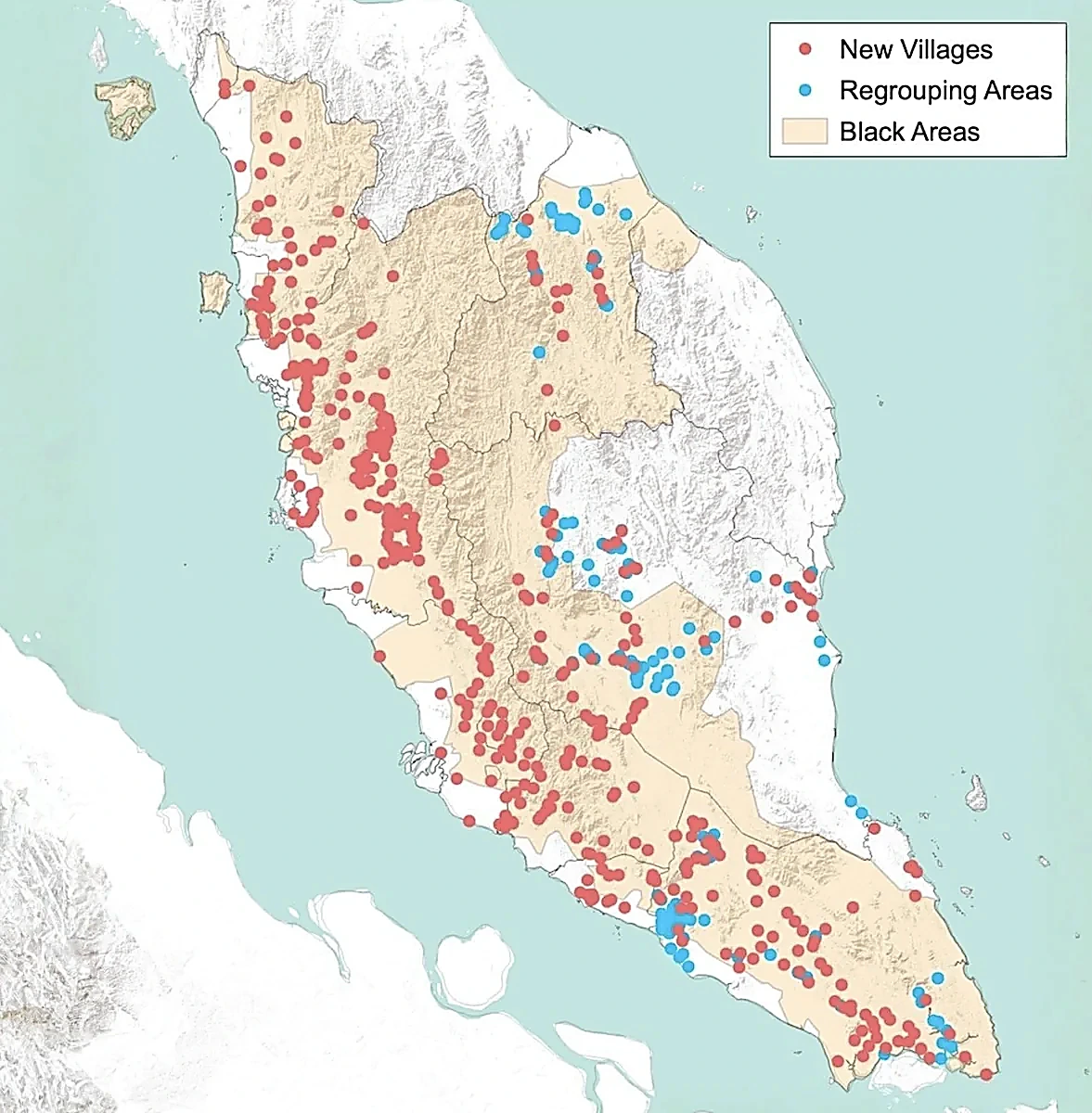
地图上触目惊心的红蓝斑点与米色阴影,完整记录了大英帝国为扑灭独立火种而施展的国家暴力机器:红点为强行焚毁沿林民宅、圈禁五十多万垦民并实行断粮搜身与针刺罐头政策的新村集中营;蓝点为强令庄园主修筑栅栏、由特别武装警察全天候看押六十多万橡胶与锡矿工人的准军事化重组区;米色阴影则是被殖民当局划定为马共游击根据地、施加长达十余小时宵禁、空中焦土轰炸与格杀勿论的最高危黑区。殖民者企图以清剿、控制与绝粮封锁切断游击队的鱼水联系,反动围剿的残酷程度世所罕见。
然而,马共指战员与广大劳苦同胞生死相依,在崇山峻岭中自力更生开荒耕作,以灵活机动的游击战术接连粉碎英军的扫荡阴谋。半个多世纪以来,官方保守叙事极力宣扬所谓马来亚联合邦是“通过和平谈判、在英国殖民者的绅士风度下恩赐独立”的无耻谎言,企图全盘抹杀以马共为代表的左翼先驱在独立斗争中的决定性贡献。
The stark markers across this historical battle map document the full brutality of the imperial state apparatus: red dots mark barbed-wire New Village concentration camps detaining over 500,000 villagers under punitive food rationing; blue dots represent estate regrouping compounds keeping over 600,000 rubber and tin laborers under armed police surveillance; beige zones outline revolutionary Black Areas subject to twenty-hour curfews, aerial bombardment, and shoot-on-sight mandates.
Despite this total starvation blockade, the CPM and rural masses forged an unbreakable bond, sustaining resistance through deep jungle cultivation and fluid guerrilla warfare. For decades, conservative official narratives claimed that Malayan independence was a 'peaceful gift' benevolently granted by British colonial gentlemen, erasing the vanguard role of the communist and left-wing resistance.
大英帝国在历史上绝非拱手相让殖民特权的仁慈者。如果不是马共领导的武装力量在半岛雨林中进行长期坚韧的军事周旋,使数万英联邦正规军深陷泥潭;如果不是持久的游击消耗战令伦敦财政不堪重负、濒临破产,殖民统治者绝不会轻易启动政权交接。正是这场殊死的武装抗争,形成了一道无法跨越的战略倒逼,打破了大英帝国无限期霸占马来半岛的企图。
1957年8月31日,当独立庆典的礼炮在吉隆坡默迪卡体育场轰鸣、“Merdeka”的欢呼响彻云霄之时,历史不应遗忘:国家独立的基石,不仅写在宪制代表团的谈判桌上,更深深铭刻在各民族抗英先锋的浴血奋战中,铭刻在那些为民族解放献出生命的先烈、被捕牺牲的工运骨干,以及在新村铁丝网下默默承受苦难的百万劳苦大众身上。
Imperial powers never surrender territorial dominion out of sheer benevolence. Had the armed forces led by the CPM not maintained prolonged, resilient military resistance in the peninsula's rainforests, entangling tens of thousands of Commonwealth regular troops in an unwinnable quagmire, and had protracted guerrilla warfare not pushed Whitehall's war finances to the brink of collapse, colonial rulers would never have initiated the transfer of power. This armed struggle generated an insurmountable strategic leverage, shattering imperial plans to maintain indefinite hegemony over Malaya.
On August 31, 1957, when the proclamation of independence resounded over Merdeka Stadium in Kuala Lumpur and shouts of 'Merdeka' echoed across the land, history must record: the bedrock of national sovereignty was not built solely across constitutional negotiating tables, but was deeply rooted in the sacrifices of anti-colonial fighters across all communities, immortalized by martyrs who fell for liberation, trade unionists executed for labor rights, and millions interned behind barbed wire in New Villages.
1998年6月,在《合艾和平协议》签署近十年后,马共总书记陈平在曼谷接受马来西亚《星洲日报》独家深度专访。陈平总结这场贯穿半个世纪的民族解放运动时,作出了这一冷静而客观的历史定论。这篇随后由《星洲日报》汇编为《青山不老》的长篇专访,至今仍是各界学者与国民重新考证马来亚独立根源的核心历史文献。
Stripping away decades of official textbook myths depicting independence as a purely harmonious constitutional gift, the realities of the struggle are recorded by those who lived it. In June 1998, nearly a decade after the signing of the Hat Yai Peace Accord, CPM Secretary-General Chin Peng gave an exhaustive exclusive interview to Sin Chew Daily in Bangkok. Reflecting on half a century of anti-colonial resistance, Chin Peng delivered this sober, objective verdict. Later compiled and published by Sin Chew Daily as 'Unfinished Journey: The CPM's Odyssey,' this comprehensive interview remains a foundational historical text for scholars and citizens exploring the true origins of Malayan independence.
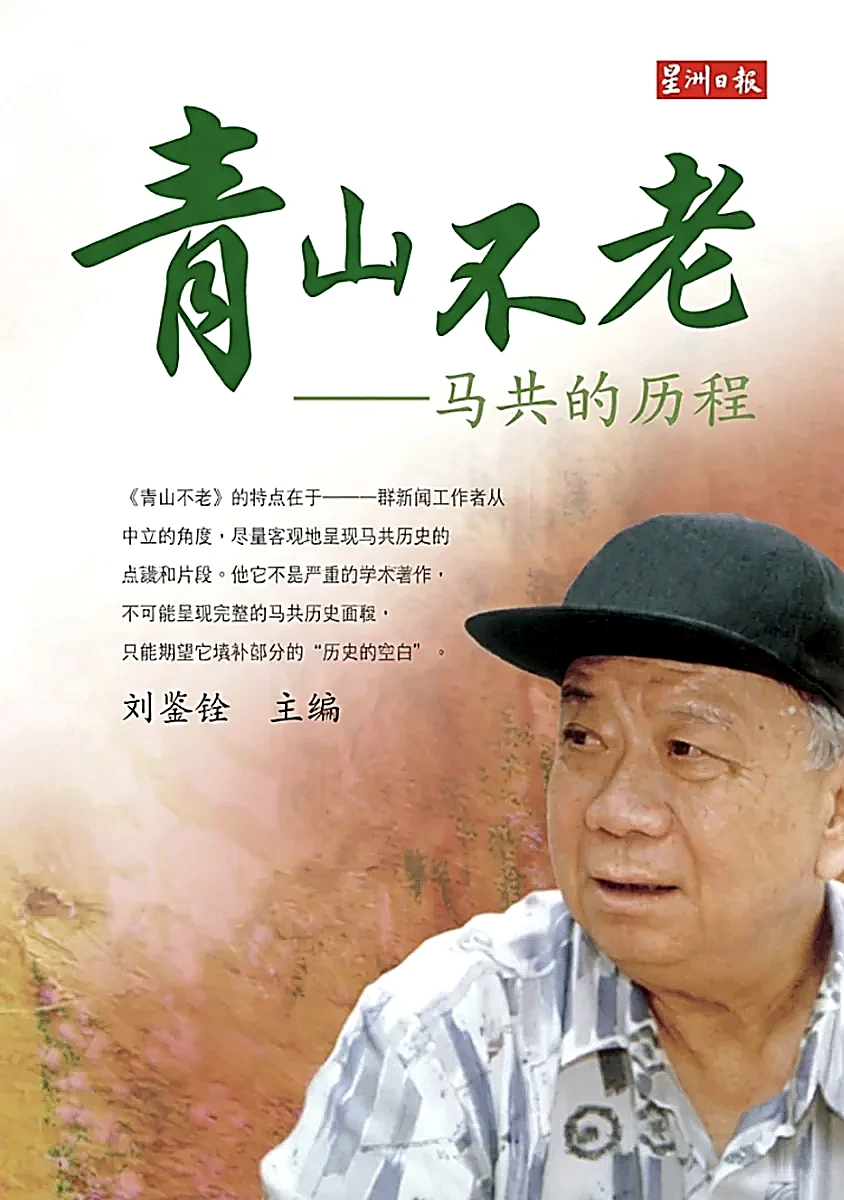
马共并不全然失败,马共最大的成就就是把英国人赶出马来亚。有人认为英国被迫提前10年,甚至25年让马来亚联合邦独立。The CPM was not a complete failure; its paramount achievement lay in compelling the British withdrawal from Malaya. Historians argue this forced Britain to grant independence to the Federation of Malaya a decade, possibly even twenty-five years ahead of its intended timeline.— 陈平(1998年6月19日-28日《星洲日报》记者独家深度专访,收入权威党史文献《青山不老:马共的历程》) | Chin Peng (Exclusive Interview with Sin Chew Daily, June 19–28, 1998; featured in 'Unfinished Journey: The CPM's Odyssey')
陈平总书记的这一论断,拨开了长期笼罩在马来亚独立叙事上的迷雾:民族独立从来不是殖民者的慈悲恩赐,也不是单靠上层精英在伦敦谈判桌上温文尔雅的请愿所能乞得。正是马来亚共产党与民族解放军在丛林与胶园中流血牺牲,打碎了大英帝国长期直接统治的财政与军事根基,才迫使殖民当局不得不加快宪政让步与主权移交的步伐。马共武装抗英斗争对加速马来亚独立所作出的历史性贡献,已经深深镌刻在半岛去殖民化的历史丰碑之上。
General Secretary Chin Peng's assessment dispels the fog that has long shrouded the narrative of Malayan independence: national independence was never a benevolent gift from the colonizer, nor could it be begged for solely through polite petitions by upper-class elites at London negotiating tables. It was the blood and sacrifice of the Communist Party of Malaya and the Malayan National Liberation Army in the jungles and rubber estates that shattered the financial and military foundations of prolonged direct British rule, compelling the colonial authorities to accelerate constitutional concessions and the transfer of sovereignty. The historic contribution of the CPM's anti-British armed struggle to accelerating Malayan independence is permanently engraved upon the monument of the peninsula's decolonization.
在这场反抗英帝殖民统治的斗争中,马共和民族解放军的无数优秀成员为国家的独立、民族的解放牺牲了他们的生命。根据英殖民政府的统计资料,在这场战争中,共有六千七百一十名(6,710名)抗英志士献出了他们宝贵的生命。这六千七百一十位英烈,涵盖了马来亚共产党中央最高领导层、各州地委与区委骨干、马来亚民族解放军各支队指战员以及各族工运与农运先驱,跨越华、巫(马来)、印三大民族,用鲜血共同浇铸了马来亚独立的历史底座。
在献出宝贵生命的六千七百一十名抗英志士中,镌刻于党史与民族解放史册的代表性英烈包括:马共中央副总书记杨果(1914-1956,于雪兰莪士毛月加蕉路突围战中壮烈牺牲)、马共雪州州委会秘书处委员兼原人民抗日军中军委副主席刘尧(1918-1948,于雪兰莪加影战斗中掩护战友突围英勇牺牲)、马共雪州州委委员小杨、马来族革命先驱马纳(Manap Jepun,战后任彭亨淡马鲁马来民族党书记,后任民族解放军第十支队分队长,在战斗中牺牲)、印族工运领袖甘纳巴蒂(S. A. Ganapathy,1917-1949,马共党员、泛马职工总会主席,于吉隆坡半山芭监狱英勇就义)、马来族抗英名将末·因特拉(Mat Indera,1920-1953,民族解放军第十支队司令部成员之一,于霹雳太平监狱英勇就义)、雪州西南区委兼中队长刘观金、民族解放军第一支队副队长兼党支部委员刘观庚、民族解放军第十二支队参谋长老马、马共雪州地委书记阿谷,以及民族解放军第十一支队司令员戴鲁焰。
In this struggle against British imperialist colonial rule, countless outstanding members of the Communist Party of Malaya and the Malayan National Liberation Army sacrificed their lives for national independence and liberation. According to statistics compiled by the British colonial government itself, a total of 6,710 anti-British fighters laid down their precious lives during this war. Spanning the Chinese, Malay, and Indian communities, these 6,710 martyrs encompassed top leaders of the CPM Central Committee, state and district party secretaries, commanders and combatants of the MNLA regiments, and pioneering trade union and peasant leaders who forged the foundation of Malayan independence with their blood.
Among the 6,710 anti-British fighters who made the supreme sacrifice, representative martyrs engraved in the annals of party history and national liberation include: Yeung Kuo (1914–1956, Deputy Secretary-General of the CPM Central Committee, who fell heroically during a breakout battle at Kachau Road, Semenyih, Selangor), Liew Yau (1918–1948, Member of the Secretariat of the CPM Selangor State Committee and former Vice-Chairman of the MPAJA Central Military Committee, who fell covering his comrades' breakout at Kajang, Selangor), Siew Yeong (Member of the CPM Selangor State Committee), Manap Jepun (ethnic Malay, postwar Secretary of the Temerloh branch of the Malay Nationalist Party PKMM and later detachment commander in the MNLA 10th Regiment), S. A. Ganapathy (1917–1949, ethnic Indian, CPM member and President of the Pan-Malayan Federation of Trade Unions, executed on the gallows at Pudu Prison in Kuala Lumpur), Mat Indera (1920–1953, ethnic Malay, member of the Headquarters of the MNLA 10th Regiment, executed at Taiping Prison in Perak), Liew Kon Kim (Selangor Southwest District Committee member and company commander), Liew Kon Keng (Deputy Commander and Party Branch Committee member of the MNLA 1st Regiment), Lao Ma (Chief of Staff of the MNLA 12th Regiment), Ah Kuk (Secretary of the CPM Selangor Regional Committee), and Tai Lu Yan (Commander of the MNLA 11th Regiment).
<strong class="text-[#771113] font-bold text-base sm:text-lg block mb-2">抗英民族解放战争英烈丰碑(6,710名牺牲志士代表名录)</strong>
在这场反抗英帝殖民统治的斗争中,马共和民族解放军的无数优秀成员为国家的独立、民族的解放牺牲了他们的生命。根据英殖民政府的统计资料,在这场战争中,共有六千七百一十名抗英志士献出了他们宝贵的生命。其中包括:
• 杨果:马共中央副总书记
• 刘尧:马共雪州州委会秘书处委员
• 小杨:马共雪州州委委员
• 马纳:马族,战后任淡马鲁马来民族党书记,后任第十支队分队长
• 甘纳巴蒂:印族,马共党员,泛马职工总会主席
• 末·因特拉:马族,第十支队司令部成员之一
• 刘观金:雪州西南区委兼中队长
• 刘观庚:民族解放军第一支队副队长、党支部委员
• 老马:民族解放军第十二支队参谋长
• 阿谷:马共雪州地委书记
• 戴鲁焰:民族解放军第十一支队司令员<strong class="text-[#771113] font-bold text-base sm:text-lg block mb-2">Roll of Honor of the Anti-British National Liberation War (Representative Martyrs among the 6,710 Fallen Fighters)</strong>— 马共文档 - 抗英烈士名录 | CPM Archival Document - Roll of Anti-British Martyrs
In this struggle against British imperialist colonial rule, countless outstanding members of the CPM and the Malayan National Liberation Army sacrificed their lives for national independence and liberation. According to British colonial government statistics, a total of 6,710 anti-British fighters laid down their precious lives in this war. Among them were:
• Yeung Kuo (Yang Guo): Deputy Secretary-General of the CPM Central Committee
• Liew Yau (Liu Yao): Member of the Secretariat of the CPM Selangor State Committee
• Siew Yeong (Xiao Yang): Member of the CPM Selangor State Committee
• Manap (Ma Na): Ethnic Malay; postwar Secretary of the Temerloh Malay Nationalist Party (PKMM), later Detachment Commander of the 10th Regiment
• S. A. Ganapathy: Ethnic Indian; CPM member and President of the Pan-Malayan Federation of Trade Unions (PMFTU)
• Mat Indera: Ethnic Malay; Member of the Headquarters of the 10th Regiment
• Liew Kon Kim (Liu Guanjin): Selangor Southwest District Committee Member and Company Commander
• Liew Kon Keng (Liu Guangeng): Deputy Commander and Party Branch Committee Member of the MNLA 1st Regiment
• Lao Ma: Chief of Staff of the MNLA 12th Regiment
• Ah Kuk (A Gu): Secretary of the CPM Selangor Regional Committee
• Tai Lu Yan (Dai Luyan): Commander of the MNLA 11th Regiment
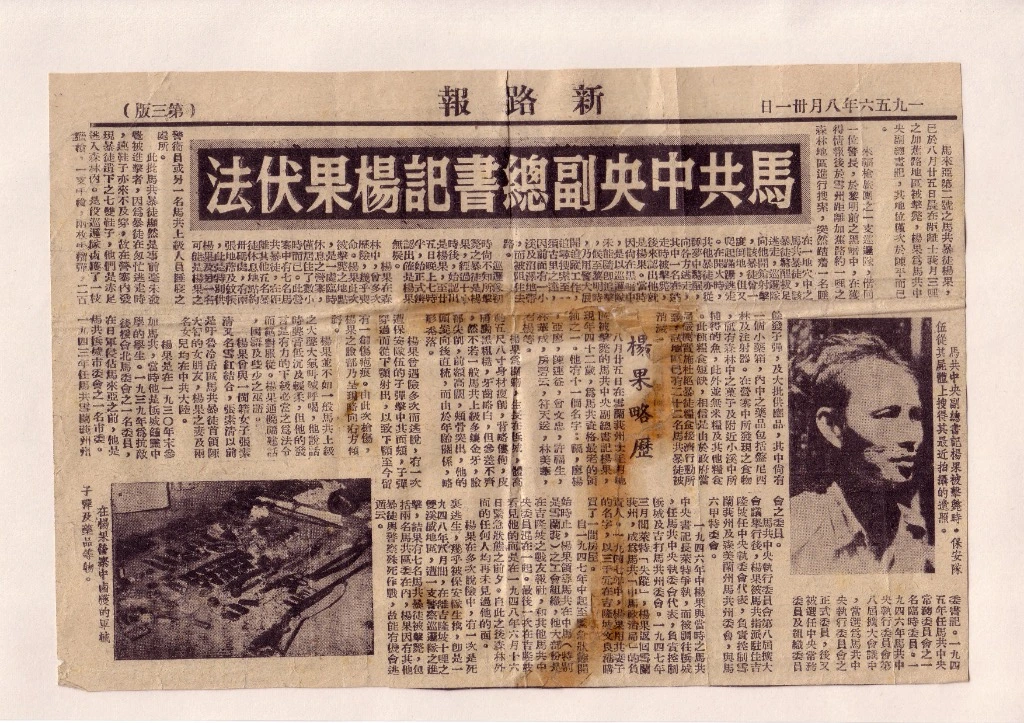
<strong class="text-[#771113] font-bold text-base sm:text-lg block mb-2">1956年8月31日《新路报》(第三版)关于马共中央副总书记杨果牺牲经过与生平之历史档案摘录</strong>
马来亚第二号之马共人员杨果,已于八月廿五日在雪兰莪士毛月区之加蕉路地区被击毙,杨果为马共中央副总书记,其地位仅次于陈平而已。
……在营幕中所发现之食物仅有深林中之果子及附近小溪中所捕得的鱼,此外并无米粮及其他粮食。此种粮食短缺,相信是由于政府当局严厉实施杜绝粮食接济行动所致。
……杨果是在一九三〇年末参加马共,当时他是槟城钟灵中学的学生。一九三九年为抗敌后援会北马委会之一名委员,在日军侵占马来亚之前,他是马共槟城市委会之一名市委。一九四三年任马共雪兰莪州委会书记。一九四五年任马共中央常务委员会之一名临时委员。一九四六年马共中央执行委员会第八届扩大会议中,当选为马共中央执行委员会之正式委员,后又被选任中央常务委员及组织委员会之委员。<strong class="text-[#771113] font-bold text-base sm:text-lg block mb-2">Archival Excerpt from Sin Lu Pao (Page 3, 31 August 1956) on the Martyrdom and Biography of CPM Deputy Secretary-General Yeung Kuo</strong>— 英殖民当局新闻处《新路报》1956年8月31日第三版历史剪报原件(剥离殖民当局心理战污蔑称谓,保留原始纪实档案) | British Colonial Information Services organ Sin Lu Pao (New Path News), August 31, 1956, Page 3 (Archival facsimile transcription)
Malaya's number-two Communist leader Yeung Kuo was shot dead on August 25 in the Kachau Road area of Semenyih District, Selangor. Yeung Kuo was Deputy Secretary-General of the CPM Central Committee, second in rank only to Chin Peng.
...The food found in the camp consisted solely of wild fruits from the deep forest and fish caught from a nearby stream, with no rice or other grain rations whatsoever. This acute food shortage is believed to be the result of the government's strict food-denial operations.
...Yeung Kuo joined the CPM in late 1930 while a student at Chung Ling High School in Penang. In 1939 he served as a member of the Northern Malaya Committee of the Anti-Enemy Backing-Up Society, and prior to the Japanese invasion he was a member of the CPM Penang Municipal Committee. In 1943 he became Secretary of the CPM Selangor State Committee, in 1945 a provisional member of the CPM Central Standing Committee, and at the Eighth Enlarged Plenum of the CPM Central Executive Committee in 1946 he was elected a full member of the Central Executive Committee, Central Standing Committee, and Organization Committee.
上列1956年8月31日英殖民当局印发的《新路报》第三版剪报,是一份极具反证价值的敌方档案。作为仅次于总书记陈平的马共中央第二号领袖,杨果(1914-1956,福建籍,生于槟城)早在1930年末求学于槟城钟灵中学时即投身马共革命洪流,历任北马抗敌后援会委员、马共槟城市委、1943年雪兰莪州委书记、1945年马共中央常务委员会临时委员;1946年八中全会当选马共中央执委、中常委兼组织委员会委员,并于同年敏锐察觉内奸莱特的背叛行径,敢于当面同莱特发生激烈争执,是协助陈平彻底清算内奸莱特右倾投降主义路线的核心元勋。1948年6月抗英民族解放战争爆发后,当马共中央主力北移之际,身为马共中央副总书记的杨果毅然留守敌情最严酷的雪兰莪、森美兰与马六甲腹地坚持指挥作战。
透过殖民当局《新路报》充满敌意的“暴徒”“伏法”等心理战辞令,依然清晰映照出令对手也不得不折服的革命者人格:报道承认杨果此前曾在突围战中被子弹击穿面颊并从下颚射出,却在1948年12月双溪毛糯双溪威等多次遭遇战中凭警卫战士殊死掩护履险如夷;承认他“牙齿洁白,但参差不齐,绝不若一般人多镶金牙”,“说话语音低沉及缓慢,但他的发言是有力的”;更记载了1956年8月25日黎明英军突袭士毛月加蕉路营地时,这位堂堂一党副帅的营幕中除了手枪、卡宾枪、两枚手榴弹和装有盘尼西林的小药箱外,“所发现之食物仅有深林中之果子及附近小溪中所捕得的鱼,此外并无米粮及其他粮食”。在1955年12月华玲和谈后仅八个月、距离1957年8月31日马来亚联合邦宣告独立仅差整整一年的历史门槛上,年仅四十二岁的杨果在加蕉路密林中赤足突围、饮弹殉国。
从1948年7月在加影掩护战友突围而牺牲的原人民抗日军副统帅刘尧、1949年5月在吉隆坡半山芭监狱高呼反殖口号走上绞架的印族工运领袖甘纳巴蒂、1953年1月在太平监狱从容就义的马来族第十支队指挥官末·因特拉,到1956年8月在士毛月绝粮密林中流尽最后一滴血的马共中央副总书记杨果,六千七百一十名各族抗英烈士用生命兑现了终结殖民统治的誓言。英烈们的牺牲,唤醒了一个民族对自由的渴望,为马来亚最终走向独立铺平了道路。
The August 31, 1956 clipping from the colonial psychological-warfare newspaper Sin Lu Pao reproduced above serves as a compelling piece of hostile archival counter-evidence. As the second-highest leader of the CPM Central Committee after Secretary-General Chin Peng, Yeung Kuo (1914–1956, born in Penang of Hokkien heritage) joined the communist movement in late 1930 while a student at Penang's Chung Ling High School. Serving successively on the Northern Malaya Committee of the Anti-Enemy Backing-Up Society, the CPM Penang Municipal Committee, as Secretary of the Selangor State Committee in 1943, and as a provisional member of the Central Standing Committee in 1945, he was elected to the Central Executive Committee, Central Standing Committee, and Organization Committee at the Eighth Enlarged Plenum in 1946. That same year, Yeung Kuo sharply confronted the traitor Lai Te and played a decisive role alongside Chin Peng in exposing and repudiating Lai Te's right-opportunist capitulationist line. Following the outbreak of the Anti-British National Liberation War in June 1948, even as the main headquarters shifted northward, Deputy Secretary-General Yeung Kuo resolutely remained behind in the heavily garrisoned heartland of Selangor, Negeri Sembilan, and Malacca to direct the guerrilla war from the front lines.
Beneath the colonial organ's hostile psychological-warfare vocabulary, the historical record reveals the moral stature of a revolutionary leader that even his adversaries could not obscure: the report acknowledges that Yeung Kuo had previously survived a bullet wound that pierced his cheek and exited through his lower jaw, and had narrowly escaped a December 1948 ambush at Sungai Way in Sungai Buloh only because his bodyguards fought to the death to cover him; it notes his plain, unpretentious demeanor and low, measured voice that commanded deep respect; and, most tellingly, it records that when British troops raided his camp at Kachau Road, Semenyih at dawn on August 25, 1956, alongside his revolver, carbine, two hand grenades, and small penicillin kit, 'the only food found in the camp consisted of wild fruits from the deep forest and fish caught from a nearby stream, with no rice or other grain rations whatsoever.' Just eight months after the Baling Peace Talks of December 1955 and almost exactly one year before the proclamation of Malayan independence on August 31, 1957, forty-two-year-old Yeung Kuo fell in action while breaking out barefoot through the Semenyih forest.
From former MPAJA Deputy Commander Liew Yau, who fell covering his comrades at Kajang in July 1948, Indian trade union leader S. A. Ganapathy, who went to the gallows at Pudu Prison in May 1949, and Malay 10th Regiment commander Mat Indera, who was executed at Taiping Prison in January 1953, to CPM Deputy Secretary-General Yeung Kuo, who shed his last drop of blood in the food-blockaded jungles of Semenyih in August 1956, 6,710 anti-British martyrs across all ethnic communities fulfilled their vow to end colonial rule with their lives. The sacrifice of these heroic martyrs awakened a nation's yearning for freedom and paved the road for Malaya's ultimate march toward independence.